So…what are your plans?

beatitudes1This weekend the Feast of the Presentation of the Lord (Feb 2nd) falls on a Sunday – and so we celebrate that event in the life of Christ.  When the Feast falls on Sunday, it replaces the Ordinary Time celebration and the associated Gospel, which happens to be “The Sermon on the Mount.”  The Sermon contains the listing of the Beatitudes and is one of the great discourses in the Gospel according to Matthew.  I thought I would at least provide some food for thought here in the column. Continue reading →

Calling Disciples: the kingdom of heaven

Calling disciplesThe Kingdom of Heaven. 21 He walked along from there and saw two other brothers, James, the son of Zebedee, and his brother John. They were in a boat, with their father Zebedee, mending their nets. He called them, 22 and immediately they left their boat and their father and followed him. 23 He went around all of Galilee, teaching in their synagogues, proclaiming the gospel of the kingdom, and curing every disease and illness among the people.

“The kingdom of heaven” is uniquely Matthew’s phrase. He often uses it in place of Mark’s “kingdom of God.” Perhaps, if we assume a Jewish background for Matthew, it is a way of avoiding saying and thus possibly misusing the name of God.

Basileia can refer to the area ruled by a king; or it can refer to the power or authority to rule as king. We probably shouldn’t interpret the “kingdom of heaven” as a place — such as the place we go when we die; but as the ruling power that emanates from heaven. One commentator translates the phrase: “heaven rules”. Continue reading →

Calling Disciples: command and promise

Calling disciplesFishing. 18 As he was walking by the Sea of Galilee, he saw two brothers, Simon who is called Peter, and his brother Andrew, casting a net into the sea; they were fishermen.

Clearly Jesus is calling the disciples to a life with him. But every “calling to” is by default a “calling from” in some sense. Fishing was not as easy as getting a boat and having at it. Fishing was controlled by the “powers that be” in two ways. (1) Commercial fishermen worked for the royal family or wealthy landlords who contracted with them to provide a specific amount of fish at a certain time. They were paid either with cash or with fish. (2) Fishermen leased their fishing rights from persons called “toll collectors” in the NT for a percentage of the catch. The “tax” could be as much as 40% (see Malina & Rohrbach, Social-Science Commentary on the Synoptic Gospels, p. 44). Continue reading →

Calling Disciples: fulfillment and calling

Calling disciplesAfter being identified as the Son of God in the baptism account (3:13–17) and after proving what kind of Son of God he is (4:1–11), Jesus journeys from Judea to Galilee in order to begin his public ministry (4:12–17). In the course of this journey Jesus will call his core disciples (vv.18-22) and witness to his proclamation with powerful deeds (vv.23-25). His journey will cover the wilderness of Judea and the towns of Galilee.

But all this begins with the barest of comments: “When he heard that John had been arrested, he withdrew to Galilee.” (v.12) The word used for arrest (paradidomi) almost becomes the technical term for Jesus’ “betrayal”. There are parallels between the fates of John and Jesus. At this point we do not know why John was arrested or by whom until (cf. 14:1-12.) Yet, his arrest strongly suggests that the powers from Jerusalem reacted negatively to his practice of baptism, his call for repentance, and the proclamation that the kingdom was upon them. The authorities must have not have shared the hope of the kingdom’s coming but that rather viewed it all as a threat. Jesus’ proclamation (v. 17) is exactly the same as John’s (3:2). It is not likely to go well for Jesus. Continue reading →

Calling Disciples: a context

Calling disciplesThird Sunday in Ordinary Time
Matthew 4:12-23(25) 

12 When he heard that John had been arrested, he withdrew to Galilee. 13 He left Nazareth and went to live in Capernaum by the sea, in the region of Zebulun and Naphtali, 14 that what had been said through Isaiah the prophet might be fulfilled: 15 “Land of Zebulun and land of Naphtali, the way to the sea, beyond the Jordan, Galilee of the Gentiles, 16 the people who sit in darkness have seen a great light, on those dwelling in a land overshadowed by death light has arisen.” 17 From that time on, Jesus began to preach and say, “Repent, for the kingdom of heaven is at hand.” 18 As he was walking by the Sea of Galilee, he saw two brothers, Simon who is called Peter, and his brother Andrew, casting a net into the sea; they were fishermen. 19 He said to them, “Come after me, and I will make you fishers of men.” 20 At once they left their nets and followed him. 21 He walked along from there and saw two other brothers, James, the son of Zebedee, and his brother John. They were in a boat, with their father Zebedee, mending their nets. He called them, 22 and immediately they left their boat and their father and followed him. 23 He went around all of Galilee, teaching in their synagogues, proclaiming the gospel of the kingdom, and curing every disease and illness among the people. Continue reading →

“the voice of one crying out in the wilderness”

IsaiahprophetThe OT Context of Isaiah 40:3  After affirming three times who he is not, John the Baptist at long last tells his interrogators who he is. Even though he is none of the scriptural figures expected to make their appearance in Israel in the last days, John does respond in terms of a figure spoken of in Scripture. He is “the voice of one crying out in the wilderness, ‘Make straight the way of the Lord’ ” (John 1:23) featured in Isaiah 40:3

Isaiah 40:3 constitutes the opening of the second of four well-defined speeches in Isa 40:1–9. The entire passage serves as a prologue that sets the tone for Isa 40–48, and indeed for the rest of the book, by announcing the intentions of Yahweh. After all the judgment and condemnation sounded in Isa 1–39, the opening of chapter 40 marks a major shift in orientation, introducing the theme of comfort that represents the leitmotiv for the remainder of the book. Continue reading →

The Baptism of Jesus – Why?

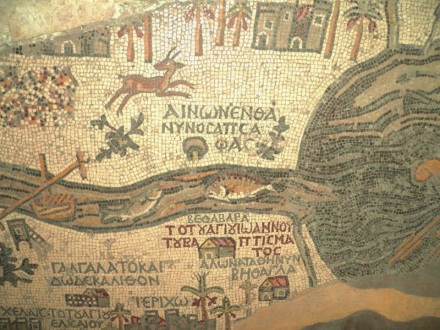
Part of the ancient Madaba Map showing two possible locations of Jesus’ baptism

Part of the ancient Madaba Map showing two possible locations of Jesus’ baptism

Did you ever wonder why Jesus was baptized? This event is recorded in the Canonical Gospels of Matthew, Mark, and Luke. In John 1:29-33, rather than a direct narrative, John the Baptist bears witness to the episode. Here is a part of the Lucan narrative (Luke 3:21–22):21 After all the people had been baptized and Jesus also had been baptized and was praying, heaven was opened 22 and the Holy Spirit descended upon him in bodily form like a dove. And a voice came from heaven, “You are my beloved Son; with you I am well pleased.”

Continue reading →

Baptism of the Lord: meaning

English: Baptism of JesusMatthew 3: 13 Then Jesus came from Galilee to John at the Jordan to be baptized by him. 14 John tried to prevent him, saying, “I need to be baptized by you, and yet you are coming to me?” 15 Jesus said to him in reply, “Allow it now, for thus it is fitting for us to fulfill all righteousness.” Then he allowed him. 16 After Jesus was baptized, he came up from the water and behold, the heavens were opened (for him), and he saw the Spirit of God descending like a dove (and) coming upon him. 17 And a voice came from the heavens, saying, “This is my beloved Son, with whom I am well pleased.”

The First Temptation of Christ. Brian Stoffregen has an interesting insight about righteousness as “do, perform” what God requires of us.

John, by trying to prevent the baptism, tempts Jesus not to do all that God requires of him. He tempts Jesus to assume his proper position now: to be the more powerful one; to baptize with the judgmental Holy Spirit and fire; to meet John’s need. I don’t think that these are too dissimilar to the devil’s temptations that occur immediately after the baptism (4:1-11) — temptations for Jesus to use his power now, for his own glory; and avoid his emptying and eventually the pain and suffering of the cross.

Continue reading →

Baptism of the Lord: fulfillment

Baptism of Christ. Jesus is baptized in the Jo...Matthew 3: 13 Then Jesus came from Galilee to John at the Jordan to be baptized by him. 14 John tried to prevent him, saying, “I need to be baptized by you, and yet you are coming to me?” 15 Jesus said to him in reply, “Allow it now, for thus it is fitting for us to fulfill all righteousness.” Then he allowed him. 16 After Jesus was baptized, he came up from the water and behold, the heavens were opened (for him), and he saw the Spirit of God descending like a dove (and) coming upon him. 17 And a voice came from the heavens, saying, “This is my beloved Son, with whom I am well pleased.”

John and Jesus in Dialogue.  As John the Baptist mysteriously appeared in the wilderness, so too Jesus. John appeared proclaiming: “Repent, for the kingdom of heaven is at hand” (3:2).  It was a very public appeal to which people responded: “Jerusalem, all Judea, and the whole region around the Jordan were going out to him and were being baptized by him in the Jordan River as they acknowledged their sins” (3:5–6.) Jesus appears on the scene and Matthew makes it clear that Jesus’ purpose is to be baptized by John (v.13). Continue reading →

Baptism of the Lord: context

The baptism of Jesus by John the baptist, as i...Matthew 3: 13 Then Jesus came from Galilee to John at the Jordan to be baptized by him. 14 John tried to prevent him, saying, “I need to be baptized by you, and yet you are coming to me?” 15 Jesus said to him in reply, “Allow it now, for thus it is fitting for us to fulfill all righteousness.” Then he allowed him. 16 After Jesus was baptized, he came up from the water and behold, the heavens were opened (for him), and he saw the Spirit of God descending like a dove (and) coming upon him. 17 And a voice came from the heavens, saying, “This is my beloved Son, with whom I am well pleased.”

Context. The story of Jesus in Matthew 3:1–4:16 is bracketed by John the Baptist’s ministry.

  • In those days John the Baptist appeared, preaching in the desert of Judea (and) saying, “Repent, for the kingdom of heaven is at hand!” (3:1-2).
  • From that time on, Jesus began to preach and say, “Repent, for the kingdom of heaven is at hand.” (4:17)

John prepared the way for Jesus and his ministry. Where John’s proclamation is that the kingdom is “right around the corner,” Jesus announces that the kingdom is here in the person of the Messiah, the Son of God.  The “inauguration” of the in-breaking of the kingdom (kairos) into Time (chromos) occurs at the baptism of Jesus which serves as the occasion for the coming of the Spirit and the Father’s approval of his beloved son. Continue reading →