
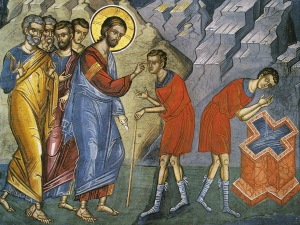
 A Man Born Blind: John 9:1-41 1 As he passed by he saw a man blind from birth. 2 His disciples asked him, “Rabbi, who sinned, this man or his parents, that he was born blind?” 3 Jesus answered, “Neither he nor his parents sinned; it is so that the works of God might be made visible through him. 4 We have to do the works of the one who sent me while it is day. Night is coming when no one can work. 5 While I am in the world, I am the light of the world.” (the remainder of the gospel can be read here).
Our narrative begins with the simple phrase “As he passed by…” It lacks the general markers (time, geography, etc.) that indicate a break in continuity, suggesting that John intends the story of the blind man to be read in continuity with the preceding chapters. So what was in the preceding chapter? The primary narrative in Chapter 8 is the “woman caught in adultery,” Jesus’ self-identification as the “light of the world,” and a long discussion between Jesus and the “Jews” about the very nature of what it means to be of the covenant people – a dialogue that occurs in the context of the Feast of Tabernacles. Continue reading
 Last year, on a Delta airlines flight from Phoenix, a tragedy occurred. During the flight, one of the passengers suffered a heart attack. His wife called out for help. The trained flight crew responded as did a passenger who was a doctor. Another passenger attended to the passenger’s wife. He offered to pray with her, to pray for her husband, and he stayed with her as the tragedy unfolded. He stayed with her as life hung in the balance. He left the plane with her and collected her luggage. He carried their luggage to the car that was waiting for him and took the woman to the hospital. He stayed with her as a doctor broke the news that her husband had died.
  In last week’s column, I was suggesting that we humans under appreciate the impact and power of habits – good and bad. The previous column, paralleling Stephen’ Covey’s “The 7 Habits of Highly Effective People,” began to explore the habits of the heart for committed Christians. The premise was that we humans are not fundamentally thinking creatures, or believing creatures, but desiring creatures. Thinking and believing are key and essential parts of who we are, but what pushes and pulls us has more to do with what captures our desires, our affections — our hearts. Our identity as persons is shaped by what we ultimately love or what we love as ultimate. It is the heart that needs formation in the Christian life. I then began to list some habits for forming a loving heart.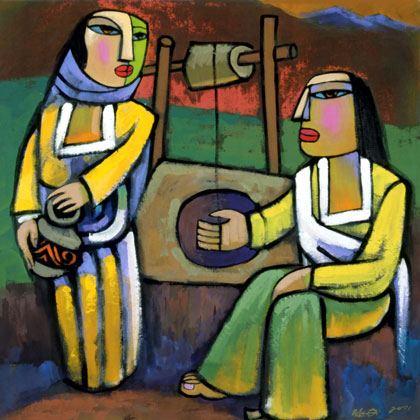
 “And he was transfigured before them; his face shone like the sun and his clothes became white as light.” (Mt 17:2) Transfigured, metamorphoo – to change the visible appearance; I used to think that maybe Epiphany would have been a better title for what happened on the mountain top. Epiphany meaning the revealing or the unveiling. Then again, I don’t think the full glory of God was revealed; just a single layer was pealed back. Perhaps transfigured is the better word. How much more could the apostles have seen and heard – and, more importantly, to begin to comprehend? The Book of Exodus 33:20 says that if we saw God face-to-face we would not survive the encounter. It would be too much for our mortal being. So, maybe it is better that only a single layer was peeled back.
  friarmusings