Calling Disciples: command and promise

Calling disciplesFishing. 18 As he was walking by the Sea of Galilee, he saw two brothers, Simon who is called Peter, and his brother Andrew, casting a net into the sea; they were fishermen.

Clearly Jesus is calling the disciples to a life with him. But every “calling to” is by default a “calling from” in some sense. Fishing was not as easy as getting a boat and having at it. Fishing was controlled by the “powers that be” in two ways. (1) Commercial fishermen worked for the royal family or wealthy landlords who contracted with them to provide a specific amount of fish at a certain time. They were paid either with cash or with fish. (2) Fishermen leased their fishing rights from persons called “toll collectors” in the NT for a percentage of the catch. The “tax” could be as much as 40% (see Malina & Rohrbach, Social-Science Commentary on the Synoptic Gospels, p. 44). Continue reading →

Calling Disciples: fulfillment and calling

Calling disciplesAfter being identified as the Son of God in the baptism account (3:13–17) and after proving what kind of Son of God he is (4:1–11), Jesus journeys from Judea to Galilee in order to begin his public ministry (4:12–17). In the course of this journey Jesus will call his core disciples (vv.18-22) and witness to his proclamation with powerful deeds (vv.23-25). His journey will cover the wilderness of Judea and the towns of Galilee.

But all this begins with the barest of comments: “When he heard that John had been arrested, he withdrew to Galilee.” (v.12) The word used for arrest (paradidomi) almost becomes the technical term for Jesus’ “betrayal”. There are parallels between the fates of John and Jesus. At this point we do not know why John was arrested or by whom until (cf. 14:1-12.) Yet, his arrest strongly suggests that the powers from Jerusalem reacted negatively to his practice of baptism, his call for repentance, and the proclamation that the kingdom was upon them. The authorities must have not have shared the hope of the kingdom’s coming but that rather viewed it all as a threat. Jesus’ proclamation (v. 17) is exactly the same as John’s (3:2). It is not likely to go well for Jesus. Continue reading →

Calling Disciples: a context

Calling disciplesThird Sunday in Ordinary Time
Matthew 4:12-23(25) 

12 When he heard that John had been arrested, he withdrew to Galilee. 13 He left Nazareth and went to live in Capernaum by the sea, in the region of Zebulun and Naphtali, 14 that what had been said through Isaiah the prophet might be fulfilled: 15 “Land of Zebulun and land of Naphtali, the way to the sea, beyond the Jordan, Galilee of the Gentiles, 16 the people who sit in darkness have seen a great light, on those dwelling in a land overshadowed by death light has arisen.” 17 From that time on, Jesus began to preach and say, “Repent, for the kingdom of heaven is at hand.” 18 As he was walking by the Sea of Galilee, he saw two brothers, Simon who is called Peter, and his brother Andrew, casting a net into the sea; they were fishermen. 19 He said to them, “Come after me, and I will make you fishers of men.” 20 At once they left their nets and followed him. 21 He walked along from there and saw two other brothers, James, the son of Zebedee, and his brother John. They were in a boat, with their father Zebedee, mending their nets. He called them, 22 and immediately they left their boat and their father and followed him. 23 He went around all of Galilee, teaching in their synagogues, proclaiming the gospel of the kingdom, and curing every disease and illness among the people. Continue reading →

A Light to the Nations – giving voice to Faith

light2nationsOver the last several Sundays I have been connecting the readings beginning with Holy Family Sunday.  St. Paul gave us advice on being a holy family: to put on heartfelt compassion, kindness, humility, gentleness, patience, forbearance, forgiveness, and over all these, love. (cf. Col 3:12-13). And so I encourage you to use your family to practice those virtues, to become the embodiment of those virtues. Then on Epiphany Sunday, the message was to reveal those virtues to the world through your life – to become the epiphany of Christ to others. The Feast of the Baptism of the Lord followed in which the prophet Isaiah’s word says that in our baptism we are formed as a covenant the people – a vow, a promise, a bond, a connection that binds us to the promise and the power of Christ on one side and to the world on the other.

And so with good intent and hopeful hearts we work away in our personal lives and in our families – to be the person, the family, the witnesses to heartfelt compassion, kindness, humility, gentleness, patience, forbearance, forgiveness, and over all these, love. We want those virtues in our lives and in our families, but have we been practicing them? Have been talking about them within the family. I suspect most of us pray about it, we work at it, we succeed, we fail, we start over… mostly silently.  And think about it. If we are hesitant to speak about it within the safety of home, how likely are we to testify about it all in the company of others.? Continue reading →

“the voice of one crying out in the wilderness”

IsaiahprophetThe OT Context of Isaiah 40:3  After affirming three times who he is not, John the Baptist at long last tells his interrogators who he is. Even though he is none of the scriptural figures expected to make their appearance in Israel in the last days, John does respond in terms of a figure spoken of in Scripture. He is “the voice of one crying out in the wilderness, ‘Make straight the way of the Lord’ ” (John 1:23) featured in Isaiah 40:3

Isaiah 40:3 constitutes the opening of the second of four well-defined speeches in Isa 40:1–9. The entire passage serves as a prologue that sets the tone for Isa 40–48, and indeed for the rest of the book, by announcing the intentions of Yahweh. After all the judgment and condemnation sounded in Isa 1–39, the opening of chapter 40 marks a major shift in orientation, introducing the theme of comfort that represents the leitmotiv for the remainder of the book. Continue reading →

Behold the Lamb of God: commentary

I-saw-the-Spirit-come2John 1:29-34 29 The next day he saw Jesus coming toward him and said, “Behold, the Lamb of God, who takes away the sin of the world. 30  He is the one of whom I said, ‘A man is coming after me who ranks ahead of me because he existed before me.’ 31 I did not know him, but the reason why I came baptizing with water was that he might be made known to Israel.” 32 John testified further, saying, “I saw the Spirit come down like a dove from the sky and remain upon him. 33 I did not know him, but the one who sent me to baptize with water told me, ‘On whomever you see the Spirit come down and remain, he is the one who will baptize with the holy Spirit.’ 34  Now I have seen and testified that he is the Son of God.”

Commentary. After John’s interrogation by priests, Levites and Pharisees, the evangelist tells us, The next day John saw Jesus coming towards him and said, ‘Look, the Lamb of God, who takes away the sin of the world!’ This is but the start of a short, compact testimony by the Baptist witnessing to the One he had just baptized. Continue reading →

Behold the Lamb of God: context

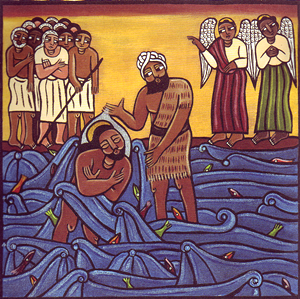
Baptism-JesusJohn 1:29-34 29 The next day he saw Jesus coming toward him and said, “Behold, the Lamb of God, who takes away the sin of the world. 30  He is the one of whom I said, ‘A man is coming after me who ranks ahead of me because he existed before me.’ 31 I did not know him, but the reason why I came baptizing with water was that he might be made known to Israel.” 32 John testified further, saying, “I saw the Spirit come down like a dove from the sky and remain upon him. 33 I did not know him, but the one who sent me to baptize with water told me, ‘On whomever you see the Spirit come down and remain, he is the one who will baptize with the holy Spirit.’ 34  Now I have seen and testified that he is the Son of God.”

Context. In the prologue the Fourth Evangelist presented John as “a man sent from God” who “came for testimony, to testify to the light, so that all might believe through him. He was not the light, but came to testify to the light.” (John 1:6-8; see also 1:15; and later 5:33) This opening characterization sets the stage for the narration of John’s ministry in 1:19–34. John’s identity is further probed when he is called to account by a delegation sent by the Jewish leaders in Jerusalem. Three times John denies being a particular end-time figure: the Christ (1:20; cf. 1:8, 15); Elijah (1:21a); the Prophet (1:21b; cf. 6:14; 7:40; cf. Deut. 18:15, 18). Continue reading →

A Covenant of the People

Baptism-JesusTwo Sundays ago, on the Feast of the Holy Family,  we listened to some of the best advise about how to become a holy family. St. Paul wrote in the Letter to the Colossians: “Put on,… heartfelt compassion, kindness, humility, gentleness, and patience, bearing with one another and forgiving one another…And over all these put on love” (Col 3:12-13).  It raises the question to all of us, in whatever form our families take, are we practicing those virtues in order to become a holy family?  Would someone on the outside peer into our families and see evidence of those virtues? Continue reading →

Baptized, Sent, and Falling Short

Homa Bay, on Winam Gulf, Lake Victoria, Kenya;...

Homa Bay,Kenya

You’ve seen the movies: a person is in danger, slipping off a cliff or a building or some other perilous perch. Another person grasps them by the hand and desperately tries to pull him or her to safety. That is the image Isaiah gives us: God grasps the chosen servant by the hand and hangs on for dear life.  “I have grasped you by the hand; I formed you, and set you as a covenant to the people” (Is 42:6). It is an image that  Pope Benedict XVI sees in his book Jesus of Nazareth. Jesus, the sinless one, plunges into the waters of our life, grasps a new covenant people by the hand, rises from the waters, all the while hanging on for dear life – our life.  And we are baptized into Christ, raised toward eternal life, commissioned to journey through this life.  Baptized and sent.

18 years ago, on the 2nd day of my mission to Kenya, I found myself in the back seat, traveling by car from Kisumu to Homa Bay on a mostly rough, uneven, dusty and rock-strewn dirt road only meters from Lake Victoria. The land was dry, parched, and in need of irrigation – all the result of irrigation projects promised but never seemingly a high enough national priority for this out-of-the-way corner of the nation.  Later we were to discover we were between the short rains of December and the long rains of July and August – and in reality, at the beginning of a year-long drought. Continue reading →

The Things We Know….or should…

Baptism-JesusYou know your birthday.  You know your significant other’s birthday – or if you don’t you should learn it quickly!  You know your anniversary.  If you’re a priest like myself, you know your date of ordination.  But….do you know the date of your baptism?

It is a question Pope Benedict asked in his first general audience of 2014.  Heck of a question, heh? Here are some of Pope Francis’ insights: Continue reading →