Opening the doors…

PopeFrancisThis past week, at a daily Mass, Pope Francis shared some wonderful thoughts that I thought would be good to share here on the Solemnity of the Body and Blood of Christ.  He said, “I remember once, coming out of the city of Salta, on the patronal feast, there was a humble lady who asked for a priest’s blessing.  The priest said, ‘All right, but you were at the Mass’ and explained the whole theology of blessing in the church.  ‘Ah, thank you father, yes father,’ said the woman.  When the priest had gone, the woman turned to another priest:  ‘Give me your blessing!’  All these words [of the first priest] did not register with her, because she had another necessity:  the need to be touched by the Lord.  That is the faith that we always look for, this is the faith that brings the Holy Spirit.  We must facilitate it, make it grow, help it grow.”

The question he raised is do we as Church, as pastors, as priests, and as the faithful help other people’s faith to grow?

The Pope also mentioned the story of the blind man of Jericho, who was rebuked by the disciples because he cried to the Lord, “Jesus, Son of David, have mercy on me!”  The Pope said, “The Gospel says that they didn’t want him to shout, they wanted him not to shout but he wanted to shout more, why?  Because he had faith in Jesus!  The Holy Spirit had put faith in his heart.  And they said, ‘No, you cannot do this!  You don’t shout to the Lord.  Protocol does not allow it.’”

This weekend past, someone mentioned that after my homily she wanted to stand up and give out an “Amen” and applause.  Over the particular quality or delivery of the homily?  No, I think because she was moved by the Spirit… but our “protocol” does not allow such things in the church – just not done in the Catholic Church, don’t you know?

Maybe it is that we try to control the Holy Spirit – or as the Pope remarked, “try and take possession of the Lord.”  It can become very dangerous if we try to overly bind the Sacraments in rules that blind us to the movements of the Spirit in a person.  The Pope remarked:  “Think about a single mother who goes to church, in the parish and to the secretary she says:  ‘I want my child baptized.’  And then this Christian, this Christian says:  ‘No, you cannot because you’re not married!’  But look, this girl who had the courage to carry her pregnancy and not to return her son to the sender, what is it [that she faces]?  A closed door!  This is not zeal!  It is far from the Lord!  It does not open doors!’”

As Christians we have a choice:  we can be “the controllers of faith, or the facilitators of the faith of the people…[or] We think today of Jesus, who always wants us all to be closer to Him, we think of the Holy People of God, a simple people, who want to get closer to Jesus, and we think of so many Christians of goodwill who are wrong and that instead of opening a door they close the door of goodwill … So we ask the Lord that all those who come to the Church find the doors open, find the doors open, open to meet this love of Jesus.  We ask this grace.”
Corpus Christi

InRemembranceThis coming Sunday, the second reading – from 1 First Corinthians – calls us all to consider how and why we participate in the Holy Eucharist.

Introduction.  First Corinthians 11-14 deals with problems in the services of worship at the church of Corinth. Verses 2-16 of chapters 11 addressed the question of women covering their heads while praying and prophesying in the service of worship. Problems with the Lord’s Supper are treated in 1 Corinthians 11:17-34. Paul then moves on to the question of spiritual gifts and the exercise of prophecy, tongues, and interpretation. Continue reading →

Through Mercy’s Pane

Hand soft upon the window
Reaching out to touch the time just past

New York City school yards
In the cold spring
Winds eddy between the buildings
Pushing the laughter and unrestrained excess of recess
Young girls speak their hidden language with furtive fleeting looks
Eyes reveal their hidden whispers
The boys, oblivious and parading
Do what only boys could understand, care to understand

Teachers seize an uninterrupted moment
A passing bit of quiet in the smoky haze
As the day drags on
A respite before they all return

She traces simple lines and arcs in the cold spring frost
On Mercy’s pane
Watching the time just pass

“Yahweh God shaped man from the soil of the earth
And blew the breath of life into his nostrils
And man became a living being”

That breath passes from generation to generation
A chain of life connecting grandmothers, mothers, and daughters
The breath of God flowing
So wondrous

Tears soft upon her cheek
For reasons she does not yet know

Only a child
Someone’s daughter
Soon now a mother
A new link in that chain
Watching her yesterday on the playground
Not yet able to imagine what is lost or what lays ahead
Or the gentle mercy she will need

– June 26, 2001

Holy Trinity Sunday – why we celebrate

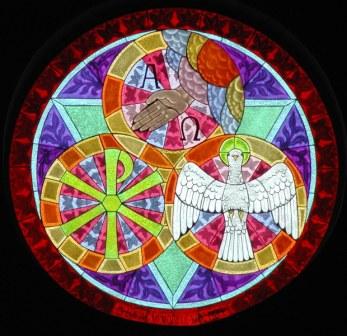
HolyTrinityWindowWe have all kinds of solemnities, feast days, and other special days in the church year. We commemorate happenings in the life of Christ: Mary’s visit from Gabriel announcing the miraculous child she was to bear into the world. We celebrate the arrival of the Three Kings, the Baptism of our Lord, the Transfiguration when the glory of Christ is revealed, and on Palm Sunday, we celebrate Jesus riding triumphant into Jerusalem amidst palms and cheers. We celebrate the empty tomb and Resurrection of Easter, the glorious Ascension, the explosive coming of God’s spirit to the church at Pentecost … and then we have Holy Trinity Sunday.  And suddenly it is like we have moved from these great events in the life of Christ, and now…. tadah!!  We are celebrating a …..a….. a church doctrine. Continue reading →

Catching Fire…

memorial-day-shadow-soldierIt is Memorial Day Weekend – a day of remembering the men and women who died while serving in the United States Armed Forces.  Please take time to remember in prayer and thanksgiving those who paid the ultimate price in defense of our country.  And remember, too, their friends and families who still grieve their loss – from our World War II veterans to our veterans of the wars in Iraq and Afghanistan.

Memorial Day weekend is also the time when Hollywood begins to release their summer blockbusters.  Of course, some studios are releasing them earlier every year.  One of the movies coming our way is “Catching Fire,” the second of the Hunger Games trilogy authored by Suzanne Collins.  The tag line for the movie is that “every revolution begins with a spark.”

I am writing this on the afternoon of Pentecost when “catching fire” seems like an appropriate message.  It has set me to thinking about what are the sparks of faith that could start a revolution in the life of an individual parishioner, a ministry group, or an entire parish.  Maybe you can help address my musings by participating in the spiritual assessment survey.

Last summer we offered a special six-week course on covenant theology that not only sparked a lot of interest, but several people took the time to write and say how it had so changed their understanding and appreciation of God’s love for them.  This summer we are offering a six-week course on Early Church History (described in the next column).

But there are other kinds of “sparks” out there that might be wafting in the air seeking the right people to “ignite.”  Maybe it is a women’s or men’s prayer group; maybe it is a justice and peace group or a group dedicated to working for a solution to homelessness.  It could be a “Catholics Come Home” program or a series of retreats, outside speakers, and a whole host of things not yet even on our radar.

Take the survey, send an email, write a note – let your voice be heard and let your spark ignite a revolution of faith!

Francis of Assisi – to this point….

Some folks have asked for an updated page for all the articles on St. Francis of Assisi – so here is what we have “to this point.”

Francis of Assisi – An Introduction
Francis of Assisi – The Young Man
Francis of Assisi – Military Adventures
Francis of Assisi – Period of Crisis: San Damiano
Francis of Assisi – Period of Crisis: Leaving the World
Francis of Assisi – Period of Crisis: Embracing the Leper
Francis of Assisi – “And the Lord gave me brothers…”
Francis of Assisi – The Fraternity Grows and Someone Has to Lead
Francis of Assisi – An Exhortation to the Brothers
Francis of Assisi – The Itinerant Life of the Brothers
Francis of Assisi – The Disposal of Worldly Goods
Francis of Assisi – The Conversion of Clare
Francis of Assisi – A Reputation for Holiness and Miracles
Francis of Assisi – The Problems of New Growth
Francis of Assisi – Francis and Nature: Part I
Francis of Assisi – Francis and Nature: Part II
Francis of Assisi – A Sacramental View of Nature
Francis of Assisi – Francis and The Eucharist
Francis of Assisi – Integrating Into the Church
Francis of Assisi – The Word of God
Francis of Assisi – The First Missions
Francis of Assisi – The Crusades (Part 1)

Francis of Assisi – The First Missions

Francis-missionsAn earlier article had discussed the problems with the rapid growth of members within in the fledgling community friars.  The period from 1213 to 1216 is the most obscure period in Francis’ life and also one of the periods of explosive growth in the movement as the brotherhood spread well beyond Assisi.  How many friars joined the fraternity in those years?  It is impossible to say, but we do know this: in 1217 the annual meeting (called a “chapter”) made the decision to send out missions across the Alps into northern Europe, the Baltic states, and to the Crusader States in the eastern Mediterranean.  Within Italy, six provinces were established; outside of Italy, five provinces were established: Spain, northern and southern France, Germany, and Syria. Continue reading →

Francis and the Crusades – Part 1

Crusade-battleOne of the events of Francis’ life that has received scant public attention was his meeting with the sultan of Egypt, Al-Malik al-Kamil in 1219 during the so-called “Fifth Crusade.” This meeting has loomed large in the imagination of the “Franciscan world” because of its effect on the Rule of Life and in the Franciscan charism of missions, but has only recently gained public attention because of the new era of tensions with the Islamic world.  People are surprised to learn that Francis was part of a crusade – a claim that scholars argue to no end as they argue so many other aspects of Francis’ life.  Each side has generally already taken a view of the little poor man from Assisi:  Francis the loyal churchman or Francis the radical reformer.  Those views are often revelatory of how the scholar views the Crusades.  And as with all things, history has a context.

Continue reading →

…each in his own language

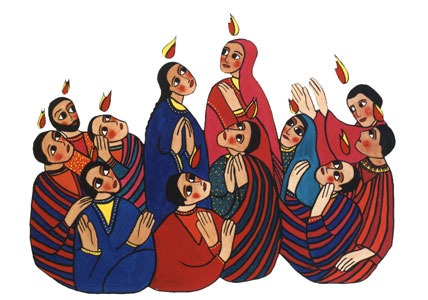
Pentecost3The description of the first Pentecost in the Acts of the Apostles tells us that when devout Jews from many different nations heard the Spirit-inspired proclamation of the gospel by the disciples, “each one heard them speaking in his own language.”  The outpouring of the Spirit of God united this very diverse group of people in a powerful moment of God’s self-revelation.  Such is the power of Spirit.

Continue reading →

The language of the Spirit

The description of the first Pentecost in the Acts of the Apostles tells us that when devout Jews from many different nations heard the Spirit-inspired proclamation of the gospel by the disciples, “each one heard them speaking in his own language.” The outpouring of the Spirit of God united this very diverse group of people in a powerful moment of God’s self-revelation.  Such is the power of Spirit.

During one of the first masses I attended in Kenya – well before I really had any clue about Kiswahili – I was sitting near a Kenyan family. Their daughter, probably about seven or eight, was wheelchair bound and was possessed of serious developmental disabilities. After the first few minutes of what turned out to be a very lengthy homily, she became agitated and began to cry out. Her mother just calmly reached out and put her arm around this little girl; she drew her close, caressed her hair and spoke to her very softly. And her little girl became quiet and peaceful. It happened again at a later point in the mass; she became troubled and began to cry. And her mother did the same thing – drew her close and calmed her. Her tenderness with her daughter was truly touching. What is more remarkable is that in Kenya there is a real reluctance to bring such children out in public. And yet there she was – with the family, in church, fully loved.  And not a word was said.

I did not understand the homily that day. But I had been privileged to see a homily between mom and daughter in a language I understood. That mom proclaimed the Easter message of the risen Christ. In her tender care for her daughter, this young mother spoke the language of the Spirit. I am sure that Saint Francis must have been smiling.

Some Catholics are disheartened by what they perceive as the “institutional church.”  Others bemoan the lack of catechetical knowledge of the faith. Others are riled that other parishioners could possibly vote for “that guy.” Others are just not very interested in the practice of faith at this time in their lives. They don’t seem to find inspiration in it; it is not compelling for them. The milieu of people, perspectives, and perceived problems are complex. And what surrounds it all is words – that too often are like a homily in Kiswahili given in Tampa.

But what is not complex is the “language of the Spirit,” the language spoken by that young mother in the church in a Kenyan slum, the language of compassion and of faithful care for the most vulnerable of our world. It is the language that we as Catholics should speak in committed service, of faithful care, of peacemaking in a violent world, of prayerful worship even when our hearts do not know rest.

And sometimes the “language of the Spirit” is in the first words we speak.  When the risen Christ appeared to his disciples on the first Easter night – disciples hiding in fear, the breath of life sucked out of them by the horror of Calvary – Jesus’ first words could have been “Where were you when I needed you most.” Instead, his greeting and his presence instill peace and healing in the midst of fear and turmoil. And then he directs these disciples to open themselves to the gift of the Spirit, the Spirit that enables them to receive and to grant forgiveness. It is only through the power of forgiveness that the air can be cleared and all can breathe in the peace for which we so long and that the Risen One desires to give. As the risen Lord, Jesus gifts his disciples with the Spirit that empowers them to be to the world what He has been. They are sent forth to the world to speak the language of the Spirit, a language of peace, of forgiveness, of generous care and faithful service, of healing and of hope.

May the Holy Spirit fill our innermost being and enable us to speak a word of hope to a world in need