
As it happens we had the same gospel just this Tuesday. It is a familiar story in which we find the disciples battling against the tempestuous waves and howling winds. Amidst this chaos, they spotted Jesus walking on the water towards them. Filled with awe and faith, Peter cried out, “Lord, if it is you, command me to come to you on the water.” Jesus responded, “Come.” And Peter, guided by faith, stepped out of the boat and began walking towards his Lord… and then he realizes he’s not in the boat. As an experienced fisherman he knows the danger of the wind and waves. Fear seizes him and he begins to sink into the chaos. Fortunately, Jesus seizes his hand, pulls him from certain death, and gets him back into the safety of the boat. The basic message on Tuesday was: “stay in the boat.” Afterwards someone emailed me to note that “sometimes the boat (Church) has leaks,” noting examples and so people “leave the boat.”
But here’s the thing… As any blue water sailor will tell you, boats inevitably have leaks. As any serious student of church history will tell you, the Church was never this pristine Church that somehow deteriorated into its present condition. As long as humanity is part of the Church, it will have leaks. Look at the original crew. Peter denies Jesus. Thomas refuses the testimony of the others. James and John argue about who is greatest. The apostles abandon Jesus at Gethsemane. Judas betrays him. And in today’s gospel those in the boat, the chosen Apostles, are frightened and confused. The Church has always been a community of flawed people. The boat has always had leaks. Leaks that need repair, major and minor – it is simply life afloat. Discovering a leak should not surprise us into abandoning ship. Thanks be to God, the holiness of the Church has never depended upon the perfection of her crew. It depends upon Christ.
Folk might complain about popes, bishops, pastors and priests, but we’re not the Captain of the ship. We are more like watch officers entrusted with the vessel, trusted to carry out the Captain’s orders. Some watch officers are excellent. Some mediocre. Some fail badly. But they don’t command the ship. Command has always been Jesus Christ. Our faith is not ultimately faith in church management. It is faith in Christ.
The Church survived Peter. It survived bad popes. It survived corrupt bishops. It survived schisms, sin, scandals, wars, and terrible human decisions. Not because leadership doesn’t matter. It matters enormously, but because Christ remains faithful even when his servants aren’t.
Peter discovers something important: the storm exists inside and outside the boat. Leaving the Church because Christians disappoint us does not transport us into a world without human failure. Every human institution leaks. Families leak. Governments leak. Businesses leak. Universities leak. And every one of us springs a leak from time to time. The question isn’t: “Can I find a community without flaws?” There isn’t one. The question is: “Where is Christ?” He is in the boat.
What should be the response when the boat springs a leak? A crew member who discovers flooding doesn’t say: “”Well, there it is, the darn ship leaks.” They report it, find the source, control the flooding and begin to repair the damage. Staying aboard doesn’t mean tolerating abuse, corruption, incompetence, or injustice. Sometimes fidelity to the Church means challenging precisely those things. Saint Catherine of Siena stayed in the boat—and challenged popes. Saint Francis stayed in the boat—and helped renew the Church. Reformers, saints, religious founders, theologians, and ordinary faithful Catholics have repeatedly repaired leaks from within. There is a difference between criticizing the boat because you hate it and repairing the boat because you love it.
And the crew turns over. Commanding officers, executive officers rotate. Department heads change. Young sailors report aboard; veterans transfer. But the ship has an identity extending beyond any particular crew. And yet the vessel continues its mission. The Church has experienced two thousand years of crew changes. Don’t confuse the current crew with the ship.
What I love about this gospel account is that Peter is both the problem and the promise. Peter gets out of the boat, sinks, and cries out: “Lord, save me!” Jesus rescues him and then brings Peter back into the boat. Problem and Promise.
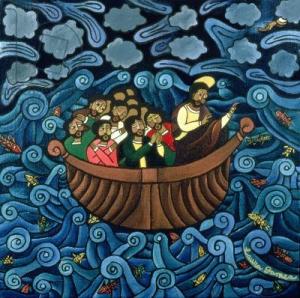
And notice that Jesus doesn’t say: “Peter, clearly boats aren’t working for you. Let’s start something else.” Jesus takes Peter back to the boat … with the frightened disciples. The Church contains frightened disciples and sinking Peters – there in the boat with Christ in the center of it all.
Boats aren’t built for harbors; they’re built for setting out on the water. The Church isn’t a pleasure boat. It doesn’t exist to provide us with a pleasant religious environment. It exists to carry the Gospel across dangerous waters where the whole Church experience might not meet one’s expectations. But that was never the point. The real point is “What mission has Christ entrusted to us?” A leaking ship still has a mission. And sometimes repairing the ship is part of the mission.
Repairs are made underway. You don’t abandon a seaworthy ship in the middle of the ocean because you discovered water where water shouldn’t be. You repair and keep sailing. You stay in the boat. Why?
Not because the Church’s leaders or fellow believers will never disappoint us. Not because the institution always gets everything right. We stay because Christ has chosen to meet us in this boat: in his Word, in the Eucharist, in reconciliation, in the communion of believers, and in the mission he entrusted to the apostles.
And Matthew’s Gospel ends the episode with something especially important. Once Jesus and Peter enter the boat: “Those who were in the boat did him homage, saying, ‘Truly, you are the Son of God.’” (Mt 14:33). And there’s the point of the gospel account. Not toward confidence in Peter’s seamanship. Not toward praise of the crew. Toward worship of Christ. That is the deepest reason to stay in the boat.
The Church is not the object of our faith. Christ is. The Church is the vessel in which Christ has chosen to gather a very imperfect crew and carry them together toward him. And when we find a leak – and we will – the faithful response is neither denial nor immediate abandonment. Grab a bucket. Find the leak. Help repair the boat. And keep your eyes on Christ.
Image credit: Jesus and Peter on the water – Gustave Brion, oil, 1880 | Public Domain
 Next Sunday is the celebration of the
