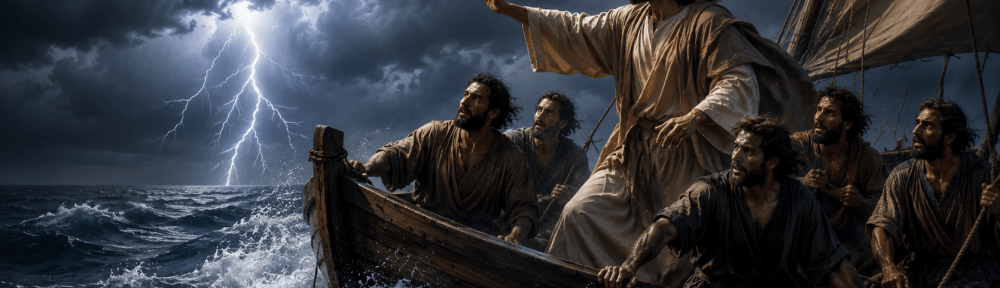
Today’s readings for Mass are an odd pair: Amos and Matthew. The first reading from the Book of Amos is a prophetic oracle of judgment. Amos speaks in stark images of roaring lions, traps, trumpets, and disasters before concluding, “Prepare to meet your God.” The Gospel from Gospel of Matthew tells the familiar story of Jesus calming the storm at sea. One sounds like doom and the end of the world; the other is a miracle story of rescue. Yet, in their own way each asks how we respond when God disrupts our sense of security?
Amos is speaking to the prosperous Northern Kingdom of Israel during a time of relative peace and economic success. The people assume that God is with them because life is good, so everything must be fine. The prophet offers a different vision. He describes a series of seemingly inevitable events. If the lion roars, that means it has prey in sight. If the city guards sound the trumpet warning, people’s natural response is to be frightened. Amos is pointing out cause and effect. Then comes the key verse: “Indeed, the Lord GOD does nothing without revealing his plan to his servants, the prophets.” (Am 3:7, NAB)
Historically, Amos preached during the reign of Jeroboam II (about 760–750 BC). It was one of Israel’s most prosperous periods. Economically trade flourished, borders expanded, and wealth increased. Spiritually and socially, however, Amos saw something very different: exploitation of the poor, corrupt courts, dishonest business practices, luxurious living by the wealthy, empty religious observance, over confidence that because Israel was God’s chosen people, disaster could never happen.
Our reading omits Amos 4:6-10, which explains the disasters: drought, failed harvests, some military defeats and more. The disasters Israel is experiencing were not random. They are prophetic wake-up calls. God has been speaking, but the people have refused to listen. There is a heartbreaking refrain that punctuates each disaster: “Yet you did not return to me.” Again and again God allowed hardship, not out of cruelty, but to call his people back. Yet they remained unmoved. Thus Amos concludes: “Prepare to meet your God.” That is not merely a threat. It is an invitation to conversion before it is too late.
“Too late” happened in In 722/721 BC, the Neo-Assyrian Empire conquered the Northern Kingdom. The capital was razed, many inhabitants were deported, and the kingdom ceased to exist.
Amos portrays a God who warns repeatedly before judgment falls. Judgment is not God’s first word. His first word is always an invitation to return. In that sense, Amos is remarkably consistent with the Gospel. God is patient, persistent, and merciful but he also takes human freedom seriously. If people continually refuse every invitation to conversion, there are real consequences. That makes Amos less a prophet of doom than a prophet of urgent hope: it is not too late to return but the time to return is now.
The Gospel is a different kind of wake-up call. The disciples also experience something that shatters their security. A violent storm threatens the boat but unlike Israel in Amos the disciples do exactly the right thing. They cry out: “Lord, save us! We are perishing!” (Mt 8:25). They do this with imperfect faith: “Why are you terrified, O you of little faith? (v.26). Nonetheless, they turn toward Christ. Israel ignored God’s warnings. The disciples run to Jesus.
Amos describes people who are spiritually asleep during good times. The disciples discover their weakness during bad times. Both groups encounter God through disruption but they respond differently.
Most of us don’t like interruptions and disruptions. We prefer stability, predictability and control. Yet throughout Scripture, God often speaks through interruptions. For Israel it was drought, famine, and military threats. For the disciples it was a storm. Today, our “interruptions” include illness, unemployment, family struggles, disappointment, and unexpected changes. The question we face is not whether disruptions come. The question is will the disruptions drive us away from God, or toward him?
There is one subtle connection between the readings. In Amos, God asks Israel to prepare to meet him. In the Gospel, the disciples discover that God is already in the boat with them. The God whom Amos tells Israel to prepare to meet is the same God who has entered the storm with his disciples in the person of Jesus.
We do indeed prepare to meet God. Not because he is distant, but because in Christ he has already come to meet us. The storms of life become not simply tests of endurance but opportunities to discover that the Lord is nearer than we realized. Jesus is already in the boat…so, stay in the boat.
Image credit: ChatGPT / Dalle-3, June 29, 2026 from prompt: “Please prepare a 1200×675 px image appropriate to the daily mass readings: Amos 3:1-8; 4:11-12 and Matthew 8:23-27.”
Discover more from friarmusings
Subscribe to get the latest posts sent to your email.

