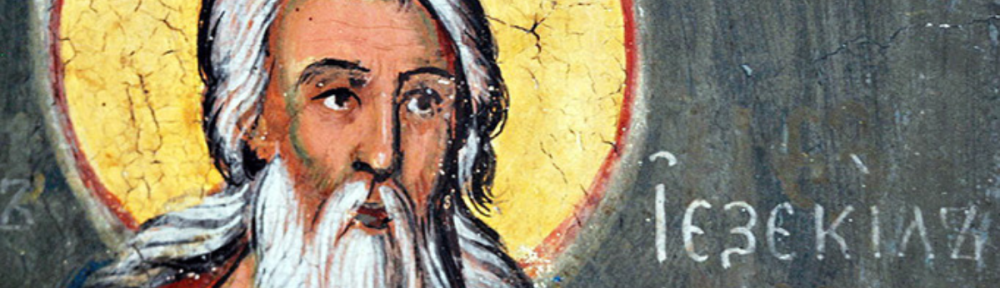
Yesterday, the meaning of the first reading, from Ezekiel, was that before the prophet can speak God’s word, he must allow God’s word to become part of him. The prophet is given terrible news. Even though the scroll given him contains “lamentation and wailing and woe” when Ezekiel eats it, “it was as sweet as honey in my mouth.” Today’s first reading (Ezekiel 9:1-7; 10:18-22) jumps into the great Temple vision of chapters 8–11.
Although not part of the reading, Chapter 8 is an important background for understanding the selected reading. Ezekiel has been shown the idolatry and corruption taking place within Jerusalem and even within the Temple precincts. Chapter 9 therefore portrays judgment coming upon the city. But then comes one of the most haunting moments in the entire book: “Then the glory of the LORD left the threshold of the temple…” (10:18) That is devastating. The Temple was supposed to signify God’s dwelling among Israel. But Israel had come dangerously close to assuming that possessing the Temple guaranteed God’s presence regardless of how the people lived.
Ezekiel overturns that assumption. God cannot be reduced to a building, institution, ritual, or religious possession.
There is an intriguing detail: the glory of God does not disappear instantaneously. Across Ezekiel 10–11 it seems almost to depart reluctantly. The glory of God passes from the Ark of the Covenant’s cherubim, to the Temple threshold, toward the east gate, and finally to the mountain east of the city (11:23). It almost reads like a divine procession of departure.
The theological disaster of 586 BC therefore isn’t simply, “Babylon destroyed our Temple.” Ezekiel’s deeper diagnosis is much more unsettling: long before Babylon destroyed the building, Israel had driven the presence of God from the center of its life.
Image credit: A fresco from St. John the Baptist Church in Kratovo, Macedonia (photo: Rašo, via Wikimedia Commons)
Discover more from friarmusings
Subscribe to get the latest posts sent to your email.

