

 While reading the Old Testament, you probably noticed there are moments of violence in which the role of the antagonist is played by the Hebrew people. The Book of Joshua, following on the heels of the Moses and the time in the wilderness, presents a narrative of the way Israel took possession of the land of Canaan, making it the land of Israel – by conquest.
The Book of Joshua is not a newspaper report or a historical reporting – most scholars hold that it was not composed at the time of Israel’s entry in the Promised Land, but is a later composition that preserves older oral narratives of Israel’s settlement of the land – especially the division of the land among the 12 tribes of Israel. If the people entered the land of Canaan circa. 1200 BCE, the initial composition is thought to be sometime between the fall of the 10 northern tribes (722 BCE) and the fall of Jerusalem (587 BCE) – some 500+ years later. The Book of Joshua should be read not so much as imparting information about how Israel took over the land of Canaan as teaching a lesson about how Israel is to avoid losing the land. It should be remembered that by the time the book was written, the Canaanites were long gone.
A comparison of Joshua with the account of Israel’s early history found in the first chapter of the Book of Judges shows that Israel’s emergence as the dominant presence in the land was a slow and piecemeal affair, not achieved at one stroke and with great ease: the Book of Joshua, with its highly idealized depiction of the “conquest,” is a cautionary tale about what the people are to do and not do in order to avoid the fate of the Northern Kingdom in losing the land.
The folks at the Bible Project have produced a nice video overview of the Book of Joshua and offers insight as to the violence described in the book.
As always, I encourage you to support the not-for-profit work of The Bible Project.
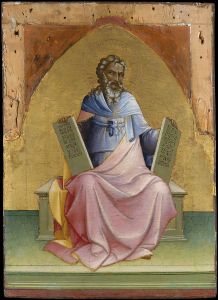 “…whoever obeys and teaches these commandments will be called greatest in the Kingdom of heaven.” (Mt 5:19)
 Forgiveness is one of those fundamental lessons we try to teach our kids from an early age: when siblings bicker or hurt each other, or if friends break a toy. And at the same time, we should ever be aware that we have not exactly mastered the art of forgiveness. The ability to forgive is a learning experience that often takes a lifetime. It’s not easy, but perhaps it’s not meant to be easy. Showing compassion and understanding in a world through which we cautiously pass takes an open heart instead of the guarded one we often carry.
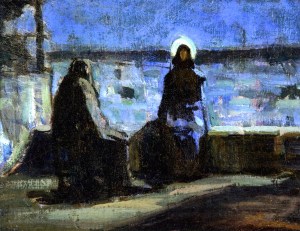 Next Sunday is the
 In the
 It has been about a year since “social distancing” became an all too familiar expression. No doubt we can all look back on the year past and collect our own anecdotes. This post is from a year ago. It is eerily accurate and still funny. Enjoy.
 One aspect of Francis’ changing life that has attracted recent attention is the movement of Francis from solitary figure, living a quasi-hermetical life for four to five years, now beginning to live in a growing community of brothers – all of whom are looking to Francis for spiritual and communal leadership. There was something attractive about Francis, his way of following the gospel, and perhaps the recent “commissioning” by Pope Innocent III gave a certain cache of legitimacy to this way of being Christian in the world. Eventually many people came to join the Franciscan movement, which soon enough became a religio and eventually an ordo, but those demarcations are eight to ten years in the future ahead of the Spring of 1209.
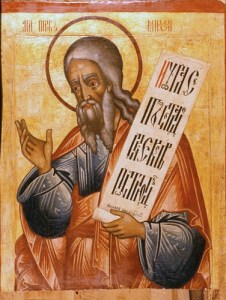 The prophet Micah preached to Jerusalem, but he was not from the city. He was an outsider from the farming village of Moresheth in the Judean foothills. You can imagine how the people, priests, and temple prophets received his prophecies of death, doom, pestilence and punishment. I am sure they would have liked to cast him away, tossed outside the city walls.
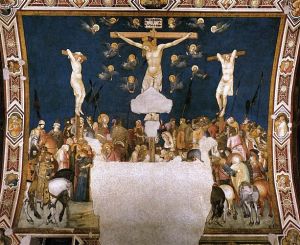 One of the famous pieces of Franciscan art can be found in the left transept of the Lower Church of San Francesco in Assisi. It is a fresco done by Pietro Lorenzetti and is one of 17 frescoes he created in the church. This fresco is located lower on the transept wall under Lorenzetti’s masterpiece, The Crucifixion. The fresco is known as Our Lady of the Sunsets.
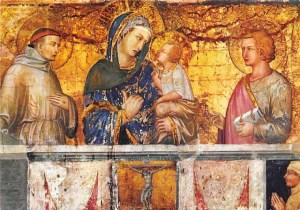 In the scene the Virgin Marry is holding the Child Jesus. The other two figures in the fresco are St. John the Evangelist (right) and St. Francis of Assisi (left), both of whom are looking at what is unfolding in the center of the scene. There Mary and Jesus are focused on each other, and Mary has a unique gesture, holding her thumb up pointing back to Saint Francis.

