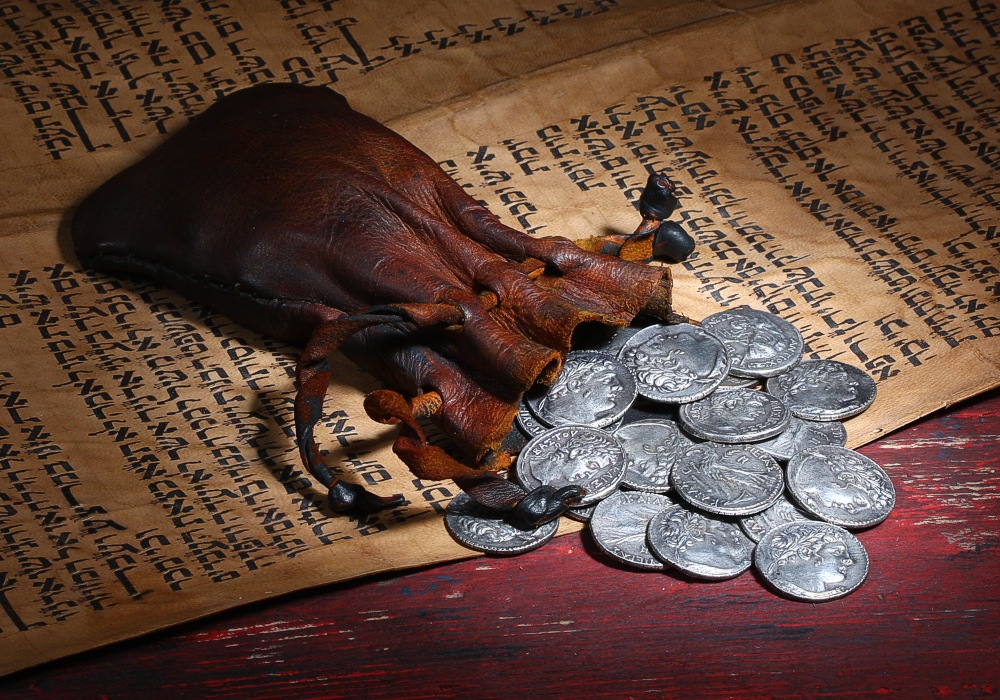
19 “There was a rich man who dressed in purple garments and fine linen and dined sumptuously each day. 20 And lying at his door was a poor man named Lazarus, covered with sores, 21 who would gladly have eaten his fill of the scraps that fell from the rich man’s table. Dogs even used to come and lick his sores. 22 When the poor man died, he was carried away by angles to the bosom of Abraham. The rich man also died and was buried, 23 and from the netherworld, where he was in torment, he raised his eyes and saw Abraham far off and Lazarus at his side. 24 And he cried out, ‘Father Abraham, have pity on me. Continue reading
Author Archives: Friar Musings
Prodigal, dishonest, and desperately clutching
In Jesus’ time, large agricultural operations such as the one described in our gospel parable were rarely run by the owner or the family, such things were left to the steward to oversee. The steward had the full faith and backing of the owner to operate the business. The steward would sell the oil and wheat production for cash, trade, or in exchange for promissory notes. The bartering that preceded the execution of the promissory note was classic commodity bargaining: I will give you so many measure of oil now, and at this future date you will repay with a higher measure of oil. There were two thing buried in the difference between the higher amount and the original amount: profit for the owner and commission for the steward. That was the way things worked. Continue reading
The Dishonest Steward – a final thought
Lessons. The teaching portion of uses parallel opposites – trustworthy/dishonest, dishonest wealth/true wealth, small/great, what belongs to another/what belongs to you. Verse 13 forms a conclusion to the parable formed by an:
- An opening assertion – No servant can serve two masters
- Two supporting observations – He will either hate one and love the other, or be devoted to one and despise the other
- The conclusion – You cannot serve God and mammon [see Note on Luke 16:9 below]
The word translated “serve” in this verse is not the usual word for serve (diakoneo), but douleuo, which more literally means, “be enslaved to” or “be controlled by.” The same word is used in 15:29 of the older son stating to his father: “Look, all these years I served you…” One cannot be controlled by God and mammon. We can have only one God – and it shouldn’t be wealth.
As in this world, so in the kingdom: trustworthiness in small things leads to a greater trust; spiritual realities but also concerned with physical stewardship (v. 13). The community of Jesus will have to deal with problems of spiritual and material stewardship as there is always the danger of subordinating the spiritual to the material without realizing that a new master has taken over.
Craddock (Luke, 191-2) concludes his comments with:
Verses 10-12 contain sayings all of which are framed on what logicians call an argument a fortiori, that is, an argument from the lesser to the greater. The life of a disciple is one of faithful attention to the frequent and familiar tasks of each day, however small and insignificant they may seem. The one faithful in today’s nickels and dimes is the one to be trusted with the big account, but it is easy to be indifferent toward small obligations while quite sincerely believing oneself fully trustworthy in major matters. The realism of these sayings is simply that life consists of a series of seemingly small opportunities. Most of us will not this week christen a ship, write a book, end a war, appoint a cabinet, dine with the queen, convert a nation, or be burned at the stake. More likely the week will present no more than chance to give a cup of water, write a note, visit a nursing home, vote for a county commissioner, teach a Sunday school class, share a meal, tell a child a story, go to choir practice, and feed the neighbor’s cat.
Notes
Luke 16:1 steward: In the Roman context a steward has access to his master’s wealth and acted as his agent in business affairs – leading to an enviable social status strongly associated with his master’s standing. The implication of losing such a position pointed to the alternatives of manual labor or begging – and homelessness as well. In other words, the steward is facing life “outside the camp” as a newly marginalized member of that world.
[1–8a] The parable of the dishonest steward has to be understood in the light of the Palestinian custom of agents acting on behalf of their masters and the usurious practices common to such agents. The dishonesty of the steward consisted in the squandering of his master’s property (Luke 16:1) and not in any subsequent graft. The master commends the dishonest steward who has forgone his own usurious commission on the business transaction by having the debtors write new notes that reflected only the real amount owed the master (i.e., minus the steward’s profit). The dishonest steward acts in this way in order to ingratiate himself with the debtors because he knows he is being dismissed from his position (Luke 16:3). The parable, then, teaches the prudent use of one’s material goods in light of an imminent crisis.
Luke 16:6 One hundred measures: literally, “one hundred baths.” A bath is a Hebrew unit of liquid measurement equivalent to eight or nine gallons.
Luke 16:7 One hundred kors: a kor is a Hebrew unit of dry measure for grain or wheat equivalent to ten or twelve bushels.
[8b–13] Several originally independent sayings of Jesus are gathered here by Luke to form the concluding application of the parable of the dishonest steward.
[8b–9] The first conclusion recommends the prudent use of one’s wealth (in the light of the coming of the end of the age) after the manner of the children of this world, represented in the parable by the dishonest steward.
Luke 16:8 dishonest steward: literally, steward of wickedness (oikonomos tes adikias)
acting prudently: other translations take the term phromimos as “cleverly” as term close to the more common word for prudence (phronesis). These are both terms that Aristotle described as a kind of practical wisdom.
children of this world: This could also be translated as “children of this age” thus drawing a parallel to Luke’s use of phrases such as “this generation.”
Luke 16:9 wealth: mamōnás [wealth, mammon] The Greek miamōmás seems to come from an Aramaic noun which most probably derives from the root ’mn (“that in which one trusts”). The word does not occur in the OT but is used in later Jewish writings in the senses (a) “resources,” (b) “gain” (especially dishonest), and (c) “compensation” or “ransom,” but also “bribe.” In general it has an ignoble sense, is often called unrighteous, and is a target of ethical censure and admonition. In the NT the word occurs only on the lips of Jesus. It denotes “earthly goods,” but always with a stress on their materialistic character. When people trust in it (Lk. 12:15ff.) or give their hearts to it (Mt. 6:21), they cannot love God. Believers, then, must break out of enslavement to it and learn to depend on God (Mt. 6:24).
eternal dwellings: literally, “eternal tents” (aiōniai skēnai), possibly echoes the exodus tradition, as it refers to the “tent” (skēnē) or tabernacle of God’s presence. The adjective “eternal” clarifies that Jesus refers not to temporary dwellings, but rather to the permanent place where God’s presence dwells.
Luke 16:10-13 Jesus’ sayings about stewardship and wealth describe “a form of stewardship that is firmly rooted in the OT understanding of Yahweh as the true owner and conferrer of all land and property” with the corollary that since property and land are given to God’s people to manage in the horizon of their accountability before God, they are to be used for the good of all, including the poor (Green, 597, cf Gen. 12:7; Exod. 3:8; 32:13; Lev. 20:45; 25; Deut. 7:13).
Luke 16:11 dishonest wealth: literally, “mammon of iniquity.” Mammon is the Greek transliteration of a Hebrew or Aramaic word that is usually explained as meaning “that in which one trusts.” The characterization of this wealth as dishonest expresses a tendency of wealth to lead one to dishonesty. Mammon is called unrighteous not because it is inherently evil but because of the unrighteous attitudes the pursuit of money can produce. If money were inherently unrighteous, then all uses of it would be evil. But that is not Jesus’ view (see 19:1-10). The attitude reflected here may be similar to that of 1 Timothy 6:10, where Paul says that the love of money is the root of all evil. Our own experience shows us that money brings out distorted values in people.
eternal dwellings: or, “eternal tents,” i.e., heaven. his opposed to the teachings.
Luke 16:10-12 The person who is trustworthy in very small matters…: The second conclusion recommends constant fidelity to those in positions of responsibility.
Luke 16:13 You cannot serve God and mammon: The third conclusion is a general statement about the incompatibility of serving God and being a slave to riches. To be dependent upon wealth is opposed to the teachings of Jesus who counseled complete dependence on the Father as one of the characteristics of the Christian disciple (Luke 12:22–39). God and mammon: see the note on Luke 16:9. Mammon is used here as if it were itself a god.
Sources
Commentaries
- R. Alan Culpepper, Luke in The New Interpreter’s Bible, Vol. IX (Nashville, TN: Abingdon Press, 1995) pp. 306-11
- Joel B. Green, The Gospel of Luke (Grand Rapids, MI: William B. Eerdmans Publishing, 1997) pp. 586-97
- Luke Timothy Johnson, The Gospel of Luke, vol. 3 of Sacra Pagina, ed. Daniel J. Harrington (Collegeville, MN: Liturgical Press, 1991) pp. 243-9
- Jerome Kodell, “Luke” in The Collegeville Bible Commentary, eds. Diane Bergant and Robert J. Karris (Collegeville, Minn.: Liturgical Press, 1989) pp.965-6
- Leon Morris,. Luke: An introduction and commentary. Tyndale New Testament Commentaries Vol. 3: (Downers Grove, IL: InterVarsity Press, 1988) pp. 254-6
- G. K. Beale and D. A. Carson, Commentary on the New Testament Use of the Old Testament (Grand Rapids, MI; Nottingham, UK: Baker Academic; Apollos, 2007) pp. 341-3
- Brian Stoffregen, “Brian P. Stoffregen Exegetical Notes” at www.crossmarks.com
Dictionaries. Gerhard Kittel, Gerhard Friedrich and Geoffrey William Bromiley, Theological Dictionary of the New Testament (Grand Rapids, Mich.: W.B. Eerdmans, 1995, c1985). F. Hauck, mamōnás, Vol. IV, pp. 388-90
Scripture – Scripture quotes from New American Bible by Confraternity of Christian Doctrine, Inc., Washington, DC. ©
The Dishonest Steward – 7 Different Whys
Using Wealth to Make Friends. The story begins when charges are brought to the rich man that the steward was squandering the rich man’s property. Similar to the rich fool (12:17), the steward begins an internal dialogue: “What shall I do?” (See the “Note” on Luke 16:1 below) Clearly the steward does not like his options: I am not strong enough to dig and I am ashamed to beg” (v.3). He thus concocts a plan to be welcomed into another rich man’s home once he has been dismissed from his current position. As the parable unfolds we see that the steward quickly decides and acts and goes about reducing an established debt owed to his current employers. The first debtor owes 900 gallons of oil; the second owes a huge amount of grain. These are well beyond household quantities and reflect a commercial operation. Continue reading
The Dishonest Steward – a conundrum
Jesus returns to the theme of use of wealth; the16th chapter begins and ends with parables. The story of the dishonest steward has been a problem for interpreters, hence its reputation as one of the most difficult parables to interpret. The root problem is the commendation (v.8) of the steward who is so plainly dishonest.
Stewards in Scripture – The figure of the steward has some significance in Christian thinking regarding one’s relationship with God. In the OT, a steward could be a chief slave/servant put in charge of a master’s household or property (Gen 43:16, 19; 44:1, 4; Is 22:15). Joseph was a steward in the house of the Pharaoh (Gen 39:4-5). The earth is the Lord’s house (Ps 24) and Moses is his steward (Num 12:7; Heb 3:1-6). In Jesus’ parables, stewards are expected to invest their talents and when fruitful are given even greater responsibilities (Lk 19:12-27).
Episcopoi are called stewards (Titus 1:5-9) and are expected to possess holy qualities as they manage the household of God. The apostle Paul also saw himself as a steward (1 Cor. 4:1-2) who would have to give an account of his stewardship (1 Cor. 4:3-4; cf. 2 Tim. 4:7-8) as the Apostle to the Gentiles (Eph. 3:2; Gal. 2:7-8; Rom. 1:5-6; 13-15). There is also a sense in which every Christian is a steward entrusted with a divine gift (1 Pet. 4:10).
These are just some of the images of stewards that part of the Christian imagination regarding the understanding of stewards.
Marks of holiness
I have to admit that in counseling conversations, pastoral settings, preaching, and a variety of teaching settings (RCIA, Bible study, etc.) I often return to the topic of the formation of moral conscience. I have even written about it here and here in this blog.
About two years, ago while preaching on the formation of moral conscience, I mentioned health care reform as a topic about which the bishops were teaching at the moment. The topic of health care per se was in the news, but the primary point of my reference was to indicate how often when our bishops speak and teach, we praise them or criticize them based on our already-held opinion of the topic. And I use the word “opinion” pointedly as it is my experience that most people do not form their conscience as described in the Catechism (§1776-1803). Such formation was the real point of the homily – with the challenge being to operate as Christians, not in the realm of opinion, but in the sphere of the formed moral conscience. We are called to do such, but do we do it? Often all I must do is to ask if they have prayed about it or asked the Holy Spirit for wisdom on the topic/decision. Lingering silence is often the answer. Continue reading
The Dishonest Steward – context
This week, I thought I might try something different, breaking up the longer posts on Scripture into smaller portions throughout the week. As a friend of mine says, “No experiment is ever a complete failure, it can always be used as an example of what not to do.”
Luke 16:1-13
1 Then he also said to his disciples, “A rich man had a steward who was reported to him for squandering his property. 2 He summoned him and said, ‘What is this I hear about you? Prepare a full account of your stewardship, because you can no longer be my steward.’ 3 The steward said to himself, ‘What shall I do, now that my master is taking the position of steward away from me? I am not strong enough to dig and I am ashamed to beg. 4 I know what I shall do so that, when I am removed from the stewardship, they may welcome me into their homes.’ 5 He called in his master’s debtors one by one. To the first he said, ‘How much do you owe my master?’ 6 He replied, ‘One hundred measures of olive oil.’ He said to him, ‘Here is your promissory note. Sit down and quickly write one for fifty.’ 7 Then to another he said, ‘And you, how much do you owe?’ He replied, ‘One hundred kors of wheat.’ He said to him, ‘Here is your promissory note; write one for eighty.’ 8 And the master commended that dishonest steward for acting prudently. “For the children of this world are more prudent in dealing with their own generation than are the children of light. 9 I tell you, make friends for yourselves with dishonest wealth, so that when it fails, you will be welcomed into eternal dwellings. 10 The person who is trustworthy in very small matters is also trustworthy in great ones; and the person who is dishonest in very small matters is also dishonest in great ones. 11 If, therefore, you are not trustworthy with dishonest wealth, who will trust you with true wealth? 12 If you are not trustworthy with what belongs to another, who will give you what is yours? 13 No servant can serve two masters. He will either hate one and love the other, or be devoted to one and despise the other. You cannot serve God and mammon.”
Context
Swirling in the milieu of our readings are themes of riches, reversals, and hospitality. Continue reading
What person having…..parables of the lost and found
Context. Many commentators locate these three parables (Luke 15) within a larger section of Luke that asks the question “who will participate in the reign of God?” (13:10-17:10). The section includes the foundational formation of the disciples – but often via the encounter with the Pharisees in which the assumptions of right relationship with God are put to the question. At issue is the question of fellowship in the community of God’s people. The setting for teaching about this fellowship is so often the meal setting where questions of boundaries and community play out in terms of admission, honor, and hospitality. So often in this section the characters with the pericopes and parables are those who should attract respect and honor according to the conventional wisdom, yet within the parables of casualties of a reversal of values and misfortunes: “For behold, some are last who will be first, and some are first who will be last” (13:30). The gospel text for his week immediately follows the unit of saying on the reversals in the Reign of God (13:10-14:35). Joel Green outlines the reversal sayings as follows: Continue reading
Immigration: The Formation of Conscience
There are strong emotions at the mention of immigration reform. There is no shortage of opinions in the news, blogs, rallies, calls to legislators, and the like. As people of faith we are called not to simply have an opinion on the matter, but rather to form our consciences on the matter (Catechism §1776-1803). The formation of conscience means to take the matter into prayer, to read and reflect on the way Scripture addresses the issue directly or indirectly, to seek the counsel of the Church, and a host of other actions. There is no shortage of opinions, but I do wonder how many take the time and effort to form our consciences? The Church is quite strong on this formation, even teaching that, “A human being must always obey the certain judgment of his [formed] conscience.” (§1790) That is an amazing responsibility that the Church asks of us. Continue reading
A Holiness Project