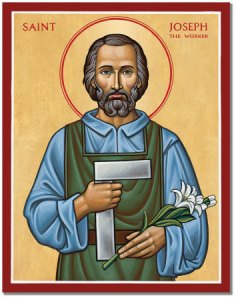
 Devotion to St. Joseph, spouse of Mary, can be traced back to the beginning of the Church, with a local feast dedicated to St. Joseph confirmed in Egypt as early as the 4th century. One of the earliest dates for honoring St. Joseph was July 20. On the Byzantine calendar St. Joseph is commemorated on December 26 with many Eastern Churches celebrating Joseph as “Holy Righteous Joseph the Betrothed.”
In the Western Church, the feast of St. Joseph wasn’t fixed until the 15th century. According to some traditions, March 19 was the day of Joseph’s death, though there is little evidence to support it, as it is unclear when Joseph died. It is certain that he was present when Jesus was 12 and “lost in the Temple” but there is no mention of him at the beginning of Jesus’ ministry, say at the wedding in Cana, when Our Lord turned the water to wine. The Bible is entirely silent about his death and as a result, the Church relies on oral traditions passed down over the centuries. Continue reading →

 This coming weekend the Gospel is John 8:1-11; the passage traditionally called “The Women Caught in Adultery.” Perhaps you have noticed that in many bibles the entire passage appear in [brackets]. The use of brackets is way to say, “what is between the brackets does not appear in all the ancient manuscripts.” The brackets are not used to say that the passage is not inspired by God. Continue reading
  Last Friday at our Men’s Prayer Group meeting, at the very end of the meeting, I offered a spiritual exercise in the light of the Sunday gospel – the Prodigal Son. The exercise was to write a letter to one of the characters in the parable.
  Here is another Lenten reflection question for you: What do St. Francis of Assisi, Pope Francis, and belonging have in common? It was almost six years ago, in March 2013, that Pope Francis famously, and perhaps controversially, said that he wanted a “poor church for the poor.” Not surprisingly, this raised an eyebrow or two. Many online commentaries excoriated the pope as an opponent of capitalism, socialist-in-religious clothing, or another South-American-reactionary-liberation theologian. Equally, many have concluded that Pope Francis wants Catholics to devote greater attention to poverty-alleviation social programs. Both miss the deeper meaning Pope Francis attaches to poverty.
  “It ain’t what you don’t know that gets you into trouble. It’s what you know for sure that just ain’t so.” A quote often attributed to Mark Twain (although it seems that “ain’t so”). Nonetheless it is a nice summary of more than one conversation on the front steps of the church. Such as the one yesterday in which someone expressed their disbelief and near shock that our parish had chosen not to celebrate or announce the holy day of obligation. After a moment of internal… “what is he talking about?…” it dawned upon me that me was referring to the Solemnity of the Annunciation, celebrated today March 25th. When I reminded him the Annunciation was not a holy day of obligation, but that we were certainly celebrating the solemnity at our Masses, I was given “the stare” and then he walked away shaking his head. Of course I can’t know his thoughts, but I have seen “the stare” before. It is the one that says, “No wonder the Catholic Church is in trouble with priests like you.” I hope he well celebrates the solemnity; I know that we will.
 I have a Lenten question for you: Are you holy? On a recent Friday at the noon Mass I asked the 100 or so folks in the pews to consider that question. I actually called on three people for answers. Their replies were (a) “not yet”, (b) “working on it”, and (c) “yes.” The “yes” was given with some enthusiasm and there followed some chuckles throughout the church – and I suspect some wonder who was the bold, brash soul that responded “yes.” Rather cheeky, one would think. What would have been your answer? I suspect the most common thought would be somewhere between “no,” “no, of course not, Saints are holy, not me,” “not holy, but I am a good person,” and “oh my, no, I am just a sinner” (said with a sincere piety).
  This morning’s
 In today’s
  Last week I wrote about making your Lenten Plan, so maybe this week we can think about the age-old question: So… “What are you giving up for Lent?” Isn’t that always the question? As if that is the reason for the season. Growing up, everything I remember about Lent circled around the acts of self-denial – what food, entertainment, or habit one would give up, and how hard it was to deny oneself of that thing. It was not always made clear that the denial was meant to help one think about God and Christ’s sacrifice.
  friarmusings