
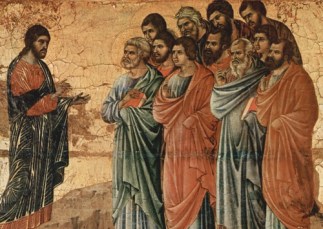
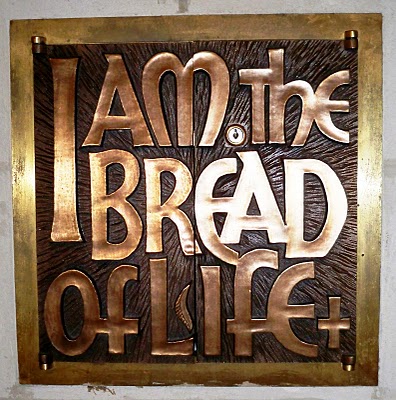
 47 Amen, amen, I say to you, whoever believes has eternal life. 48 I am the bread of life. 49 Your ancestors ate the manna in the desert, but they died; 50 this is the bread that comes down from heaven so that one may eat it and not die. 51 I am the living bread that came down from heaven; whoever eats this bread will live forever; and the bread that I will give is my flesh for the life of the world.”
The expression “Amen, amen, I say to you” (v. 47) also signals the beginning of a new section in the discourse (as before in 5:19, 24–25; 6:32). Yet this section opens with a reprise of familiar Johannine themes: The believer receives eternal life (6:27, 40); Jesus is the bread of life (6:35). These themes provide the theological grounding for what follows. As in 5:19–30, here the Fourth Evangelist advances Jesus’ argument by placing what Jesus has said previously in a new context. The interweaving and overlapping of theological themes evident here and throughout Jesus’ discourses help to create a cohesiveness of theological perspective throughout the Fourth Gospel Continue reading
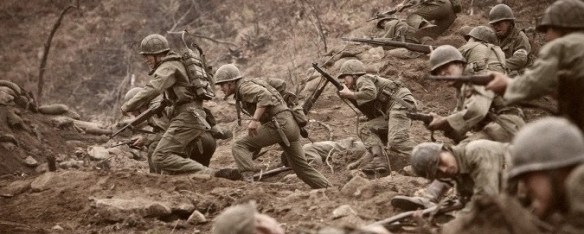 When the 1960s came around, the “Greatest Generation” – those men and women who served during World War II were still largely and stoically silent about their wartime experiences – but the television networks began television shows about the war. Series such as “Combat,” “12 O’Clock High,” and “Men at War” became staples of prime time viewing. Knowing things about WWII became part and parcel of determining one’s status within the pack (and here I am referring to Cub Scouts). Sure, you might be able to identify the German Messerschmidt 109 fighter aircraft from a flash card, but the real test was could you identify the difference between 109-C and the 109-G series (except the 109-G6 which was soooo… obvious). Clearly such things were critical to national defense among the Cub Scouts. Or so it seemed at the time.
 43 Jesus answered and said to them, “Stop murmuring among yourselves. 44 No one can come to me unless the Father who sent me draw him, and I will raise him on the last day.
 41 The Jews murmured about him because he said, “I am the bread that came down from heaven,” 42 and they said, “Is this not Jesus, the son of Joseph? Do we not know his father and mother? Then how can he say, ‘I have come down from heaven’?”
 In
 This coming Sunday,
 This coming Sunday,
 “But these are written that you may (come to) believe that Jesus is the Messiah, the Son of God, and that through this belief you may have life in his name.” (Jn 20:31)
 The year is 1221 and at the request of the “cardinal protector” of the friars, Cardinal Hugolino, Francis and several of his brothers have taken up the task of writing a formal rule of life. It was not clear that the Franciscans were actually a “religious order.” When Francis visited Pope Innocent III in 1209, the pope verbally approved (or did he?) a Rule of Life that was written down in few words. In 1216, the 4th Lateran Council ruled that no new religious orders could be formed: all new groups would be absorbed into existing religious orders. Hugolino recognized the uniqueness of the charism of St. Francis and his brothers and was determined that it not be lost to the church.
 Is the Bread of Life Discourse (John 6), metaphor or sacramental? There are many commentaries and religious traditions that insist on a metaphorical interpretation of “eat” and “drink” and thus “eat” and “drink” as metaphors for belief. There are some Catholic commentators (e.g. LaGrange) who insist there is no metaphor, that the entirety of Jesus’ discourse is sacramental/Eucharistic. As Fr. Raymond Brown and Fr. Francis Moloney point out, the truly Catholic position is “both-and.” What begins in John 6:22-50 as metaphor for belief, is ultimately answered in John 6:51-58 as Eucharist. With that in mind let us consider (a) a “big picture” view of this core question of John 6, but (b) fair warning: it does get a bit technical and dense in places. But give it a go!!

