
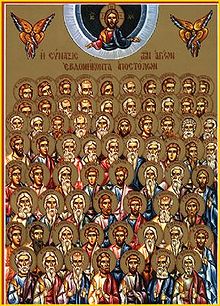
 On the evening of that first day of the week, when the doors were locked, where the disciples were, for fear of the Jews, Jesus came and stood in their midst and said to them, “Peace be with you.” (John 20:19)
It is Sunday evening, the third day after Jesus died. The disciples are gathered together in fear and confusion. Unsure of their next step. The one they thought Messiah, dead and buried – executed like a common criminal and lying in a tomb. Their leader gone and what remained was an overwhelming sense of shame because they knew they had deserted Jesus in his hour of need. And now they lived in fear. Fear of the next knock on the door. Fear of having left everything to follow Jesus…now what? A fear that seeps into the deepest regions of their being, hardening hearts and stiffening limbs; locking doors. Continue reading
 As a liturgical season, Lent is rather straightforward. It is kinda’ easy to write about. There is Ash Wednesday to dramatically mark its beginning, and we all know we are moving relentlessly towards Easter. We count the days even as we mark Lent’s beginning. The Ashes make a visible mark upon us, reminding us that we are dust and to dust we shall return – but that is not the end of the story. We are reminded to repent and believe in the Gospel – but that is not the end goal. We are encouraged to pray, fast, and give alms – but those practices are meant to make room in our lives for God that we too may rise to the newness of life at Eastertide.
 Forgiveness is one of those fundamental lessons we try to teach our kids from an early age: when siblings bicker or hurt each other, or if friends break a toy. And at the same time, we should ever be aware that we have not exactly mastered the art of forgiveness. The ability to forgive is a learning experience that often takes a lifetime. It’s not easy, but perhaps it’s not meant to be easy. Showing compassion and understanding in a world through which we cautiously pass takes an open heart instead of the guarded one we often carry.
 12 Then I turned to see whose voice it was that spoke to me, and when I turned, I saw seven gold lampstands 13 and in the midst of the lampstands one like a son of man, wearing an ankle-length robe, with a gold sash around his chest. (Rev 1:12-13)
 In Luke’ narrative there is no account of the Resurrection; there in only the empty tomb – which is not the source of faith for people in Luke’s rendering of the gospel. Rather, in Luke’s gospel it is the empty tomb
 This coming Sunday marks the
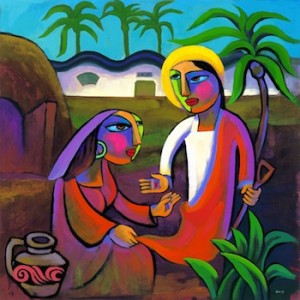 8 Then [Mary Magdalene and the other Mary] went away quickly from the tomb, fearful yet overjoyed, and ran to announce this to his disciples. 9 And behold, Jesus met them on their way and greeted them. They approached, embraced his feet, and did him homage. 10 Then Jesus said to them, “Do not be afraid. Go tell my brothers to go to Galilee, and there they will see me.”
 On the first day of the week, Mary of Magdala came to the tomb early in the morning, while it was still dark, and saw the stone removed from the tomb. So she ran and went to Simon Peter and to the other disciple whom Jesus loved, and told them, “They have taken the Lord from the tomb, and we don’t know where they put him.” So Peter and the other disciple went out and came to the tomb. They both ran, but the other disciple ran faster than Peter and arrived at the tomb first; he bent down and saw the burial cloths there, but did not go in. When Simon Peter arrived after him, he went into the tomb and saw the burial cloths there, and the cloth that had covered his head, not with the burial cloths but rolled up in a separate place. Then the other disciple also went in, the one who had arrived at the tomb first, and he saw and believed. For they did not yet understand the Scripture that he had to rise from the dead. (John 20:1-9)
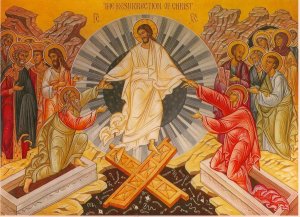 In the Book of Job, chapter 14, Job is pondering the deeper things of life. He is asking the age old question in the face of pending or possible death? Will a person, once dead, live again? (יִ֫חְיֶ֥ה cf. Job 14:14). The question has now been answered. The tomb is empty. The defining conviction of Christian hope is that because Jesus was raised from the dead, the grave is not the final reality of human experience. “Why do you seek the living one among the dead? He is risen.

