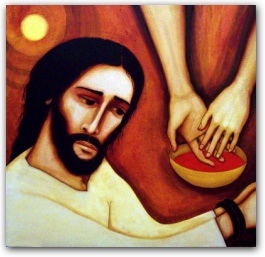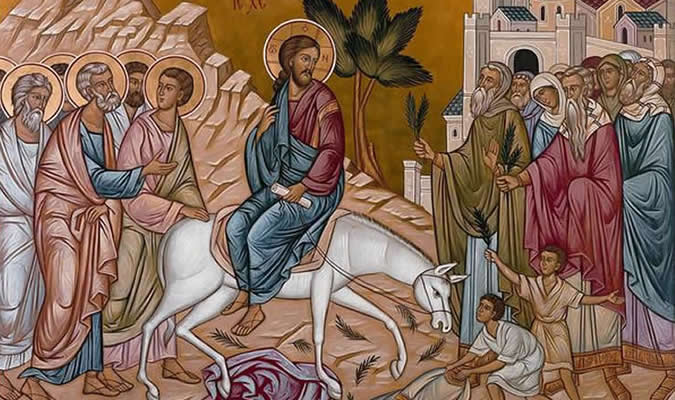
1 Six days before Passover Jesus came to Bethany, where Lazarus was, whom Jesus had raised from the dead.2 They gave a dinner for him there, and Martha served, while Lazarus was one of those reclining at table with him. 3 Mary took a liter of costly perfumed oil made from genuine aromatic nard and anointed the feet of Jesus and dried them with her hair; the house was filled with the fragrance of the oil. 4 Then Judas the Iscariot, one (of) his disciples, and the one who would betray him, said, 5 “Why was this oil not sold for three hundred days’ wages and given to the poor?” 6 He said this not because he cared about the poor but because he was a thief and held the money bag and used to steal the contributions. 7 So Jesus said, “Leave her alone. Let her keep this for the day of my burial. 8 You always have the poor with you, but you do not always have me.” 9 (The) large crowd of the Jews found out that he was there and came, not only because of Jesus, but also to see Lazarus, whom he had raised from the dead. 10 And the chief priests plotted to kill Lazarus too, 11 because many of the Jews were turning away and believing in Jesus because of him. Continue reading
Didn’t say it was easy
In a recent issue of American Magazine, Mark Neilsen wrote a wonderful piece called “Asking for Change: The challenge of giving without grudges.” He tells of his ongoing and frequent encounters with a poor woman named Donna. She appears in his life when there is need in her life. What was especially wonderful about the article was his own ongoing reflection on his reactions and emotions surrounding each encounter: “Like the time she asked me to loan her $20 for an emergency, and I came to learn that it really was not a loan at all…” Be you pastor or parishioner, in modern life almost everyone has encountered their own “Donna.” Perhaps the first time we might actually expect they will repay the loan. After that how many of us realize it isn’t a loan, but as Mark describes: “a gift, minus the generosity.” I think there are also other descriptions: “a gift, with the warning – ‘don’t let me catch you using it for any foolishness.'” Or perhaps, “a gift minus the glance” – as in never making eye contact and just hoping the moment passes as soon as possible. Continue reading
Passion Sunday: crucified
The King Is Scourged and Mocked (27:26-31a) The Gospel reading for Palm Sunday of the Lord’s Passion is quite lengthy and so will not be included here. It can be found at the USCCB website: http://www.usccb.org/bible/readings/041314.cfm
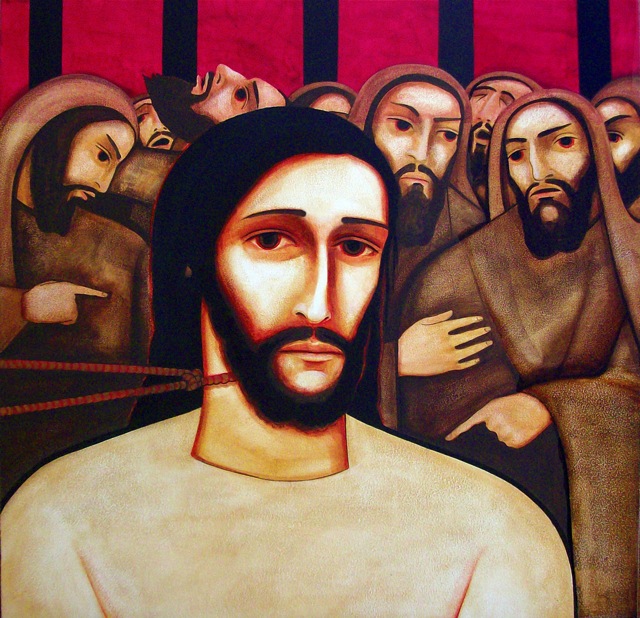
Where the religious trial ends by mocking Jesus as the Christ, the secular trial ends with Jesus being mocked as king with a scarlet cloak (a soldier’s cape) parodying the emperor’s purple robe, a reed representing a royal scepter, and the crown of thorns. Jesus is thus enthroned as king, and offered the homage of kneeling which a Hellenistic ruler required. In this scene Matthew continues to redefine what kingship means. If this scene is a coronation, then the cross will be the throne. Continue reading
Passion Sunday: condemned
Jesus Is Condemned (27:11-25) The Gospel reading for Palm Sunday of the Lord’s Passion is quite lengthy and so will not be included here. It can be found at the USCCB website: http://www.usccb.org/bible/readings/041314.cfm
This is the official trial of Jesus, and yet the description sounds less like a formal judicial hearing than an example of oriental bargaining. Pilate, as prefect of Judea, had the sole authority to acquit or to condemn, and to determine the sentence. There is a perfunctory attempt at a formal examination of the prisoner, but increasingly the dominant force is not the official role of the governor but the demands of the Jewish leaders, backed by ‘the people’. It is here that the focus of Matthew’s attention falls, so that Pilate’s role is as a cast extra on the movie set whose sole role is at best a catalyst which helps to define unequivocally the people’s stance towards the Messiah. Continue reading
Passion Sunday: trials, failures, and betrayals
The Jewish Trial Before the Sanhedrin (26:57-68) The Gospel reading for Palm Sunday of the Lord’s Passion is quite lengthy and so will not be included here. It can be found at the USCCB website.
R.T France (2007, p.1016) writes, “This is the point at which Jesus’ death is sealed; all that follows involving the Roman prefect is only the formal implementation of a verdict already decided by the Jewish authorities.” This is a conflict that has been growing unabated since the beginning of Jesus’ public ministry and has reached the point where the religious authorities are simply looking for the basis upon which they can seal Jesus’ fate. But for the moment he is in their power and he Jesus has preciously little to say. The events unfold and Jesus appears as helpless before the hearing by Jewish religious leaders. It is not likely that this is a formal trial that occurs at Caiaphas’ house, but rather an ad hoc meeting of senior people to agree on, first, the need to have Jesus executed (this being a matter of Jewish law), and secondly, an appropriate tactic to induce the Roman governor to impose the death penalty (which would, of course, require a charge of which Roman law could take cognizance). The formal Jewish trial begins, as suggested by 27:1, later when the whole Sanhedrin has assembled. Whatever the official status of the gathering, the Evangelists leave us in no doubt that it was not an unprejudiced hearing, but was convened specifically to “put him to death.” Continue reading
Passion Sunday: the sheep scatter
Jesus Predicts Desertion and Promises Reunion (26:30b-35) The Gospel reading for Palm Sunday of the Lord’s Passion is quite lengthy and so will not be included here. It can be found at the USCCB website:
One of the curious “tests” that some scholars apply to a passage regarding “authenticity” (by which they really mean historicity) is “would it embarrass the early church?” If it would, then it must be so “authentic” and compelling that the sacred writer includes it even though it is embarrassing. Jesus’ prediction that all the disciples would abandon him in his hour does not reflect well on the future leaders of the nascent Christian movement.
The NSRV says “You will all become deserters [skandallisthēsesthe]…” – and though it more literally means to “fall away” “be caused to stumble” – there is something scandalous that will shake their faith to the very core. This the word that Matthew uses to describe the hometown folk, the Pharisees, and those who profess belief in Jesus but who stumble when the world or persecution arises on account of Jesus’ word (13:21). Continue reading
Passion Sunday: A last meal
The Gospel reading for Palm Sunday of the Lord’s Passion is quite lengthy and so will not be included here. It can be found at the USCCB website:
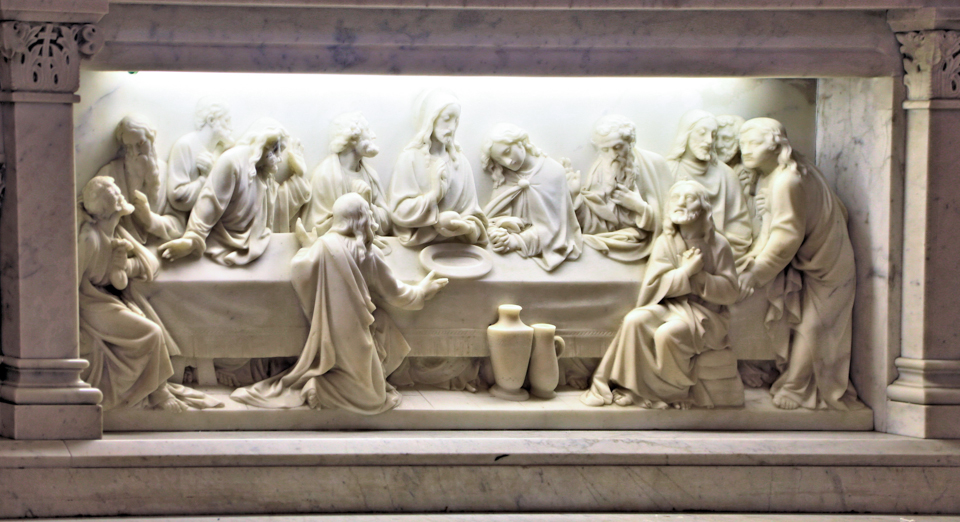
Jesus Inaugurates the Eucharist (26:26-30a) As Joachim Jeremias and other scholars have shown in looking at all the received Eucharistic traditions (Paul in 1 Corinthians and the synoptic gospel writers), Jesus follows the form and outline of the Passover Seder. The thanksgiving over the bread and the cup recorded in vv. 26 and 27 will therefore be a regular part of the main section of the Passover meal (making this the third of the four cups of the Passover), and we may reasonably assume that Jesus used the traditional words of thanksgiving. But it worthwhile to point out that said the blessing refers to blessing God, not blessing the bread. Continue reading
Passion Sunday: betrayer and betrayed
The Gospel reading for Palm Sunday of the Lord’s Passion is quite lengthy and so will not be included here. It can be found at the USCCB website:
Commentary. This very long narrative will be broken into small passages that may help the reader to focus and reflect on specific sections. The general outline listed in the previous post is provided for you to locate these smaller passages within the larger framework. The narrow framework is taken from Boring’s outline of the Matthean Passion narrative. Continue reading
Passion Sunday: context
Context. The climactic events that have been repeatedly predicted since the Galilean ministry are now about to unfold (12:38–40; 16:4, 21; 17:12, 22–23; 20:17–19; 21:38–39; 23:32). Jesus was aware of the forces arrayed against him (26:2), yet he did not resist doing the will of the Father despite the suffering that would be involved (26:36–46). Ironically, the very religious leaders who opposed and sought to destroy Jesus were the unwitting instruments God used to fulfill his plan to exalt Jesus. Continue reading
The Sign
There are no miracles in the Gospel of John. Well, at least he does not call them as such. John seems to assiduously avoid calling them miracles, preferring to call them “signs.” In fact the first part of the Gospel of John is called the “Book of Signs” – and there are seven.
- Changing water into wine in John 2:1-11
- Healing the royal official’s son in Capernaum in John 4:46-54
- Healing the paralytic at Bethesda in John 5:1-18
- Feeding the 5000 in John 6:5-14
- Jesus’ walk on water in John 6:16-24
- Healing the man born blind in John 9:1-7
- Raising of Lazarus in John 11:1-45
Each sign is meant, not only to grab your attention, but to serve as a pointer, not that which has just transpired, but to the person of Jesus. The signs also serve to point to a choice.
That has been the motif in the Gospel of John all along. At the end of the first sign, the words of the Blessed Virgin Mother in the story from Cana make it evident. Her last words in the Gospel of John are the clearest and most poignant sign: “This is my son, do what he tells you.” She points to the person of Jesus and points to the choice each will have to make: do what he tells you. Every disciples, every reader, each one who hears this Book of Signs is brought to that moment where choices are made to follow, or not, the one who is the Living Word of God made flesh, Jesus Christ. Continue reading