“The” Faith

I am partial to the Gospel according to Luke. I think his writing is good at telling the story and leaving room for the hearer to work though the implications of it all.  Some of the most memorable parables – the Good Samaritan, the Prodigal Son, Lazarus and the Rich Man, and more are all unique to Luke’s gospel. Also, Luke is particular about his choice of words and phrases – the small nuances of language find their place in his telling of Jesus’ story.

Today we have one of those small curiosities of language: But when the Son of Man comes, will he find faith on earth? (Luke 18:8).  What the Greek actually says is not “find faith” but “find the faith.” It is the only place in all of Luke’s gospel he uses this phrase.  In fact it is the only place in all the New Testament. Maybe it’s nothing, but then again, as he often does, maybe Luke is trying to tell us something in this small parable of the persistent widow and the unjust judge. Continue reading →

Pharisee and Tax Collector – A Parable

Pharisee-n-Tax Collector3Luke 18:9-14. 9 He then addressed this parable to those who were convinced of their own righteousness and despised everyone else. 10 “Two people went up to the temple area to pray; one was a Pharisee and the other was a tax collector. 11 The Pharisee took up his position and spoke this prayer to himself, ‘O God, I thank you that I am not like the rest of humanity—greedy, dishonest, adulterous—or even like this tax collector. 12 I fast twice a week, and I pay tithes on my whole income.’ 13 But the tax collector stood off at a distance and would not even raise his eyes to heaven but beat his breast and prayed, ‘O God, be merciful to me a sinner.’ 14 I tell you, the latter went home justified, not the former; for everyone who exalts himself will be humbled, and the one who humbles himself will be exalted.”

A parable of reversal or right relationship? Continue reading →

Pharisee and Tax Collector – In Prayer

Pharisee-n-Tax Collector3Luke 18:9-14. 9 He then addressed this parable to those who were convinced of their own righteousness and despised everyone else. 10 “Two people went up to the temple area to pray; one was a Pharisee and the other was a tax collector. 11 The Pharisee took up his position and spoke this prayer to himself, ‘O God, I thank you that I am not like the rest of humanity—greedy, dishonest, adulterous—or even like this tax collector. 12 I fast twice a week, and I pay tithes on my whole income.’ 13 But the tax collector stood off at a distance and would not even raise his eyes to heaven but beat his breast and prayed, ‘O God, be merciful to me a sinner.’ 14 I tell you, the latter went home justified, not the former; for everyone who exalts himself will be humbled, and the one who humbles himself will be exalted.”

The Pharisee.  The Pharisees were not villains. Continue reading →

Pharisee and Tax Collector – Righteousness

Pharisee-n-Tax Collector3Luke 18:9-14.  9 He then addressed this parable to those who were convinced of their own righteousness and despised everyone else. 10 “Two people went up to the temple area to pray; one was a Pharisee and the other was a tax collector. 11 The Pharisee took up his position and spoke this prayer to himself, ‘O God, I thank you that I am not like the rest of humanity—greedy, dishonest, adulterous—or even like this tax collector. 12 I fast twice a week, and I pay tithes on my whole income.’ 13 But the tax collector stood off at a distance and would not even raise his eyes to heaven but beat his breast and prayed, ‘O God, be merciful to me a sinner.’ 14 I tell you, the latter went home justified, not the former; for everyone who exalts himself will be humbled, and the one who humbles himself will be exalted.” Continue reading →

Pharisee and Tax Collector – Context

Pharisee-n-Tax Collector3Luke 18:9-14 – 9 He then addressed this parable to those who were convinced of their own righteousness and despised everyone else. 10 “Two people went up to the temple area to pray; one was a Pharisee and the other was a tax collector. 11 The Pharisee took up his position and spoke this prayer to himself, ‘O God, I thank you that I am not like the rest of humanity—greedy, dishonest, adulterous—or even like this tax collector. 12 I fast twice a week, and I pay tithes on my whole income.’ 13 But the tax collector stood off at a distance and would not even raise his eyes to heaven but beat his breast and prayed, ‘O God, be merciful to me a sinner.’ 14 I tell you, the latter went home justified, not the former; for everyone who exalts himself will be humbled, and the one who humbles himself will be exalted.” Continue reading →

Faith in Action

UmbrellaSummer sun and an extended drought had left the surrounding fields parched, dusty, and brown. As they tended their wilting crops, the local folks daily searched the sky for any sign of relief. Days turned into arid weeks and still no rain came.

The ministers of the local churches announced that there would be a special service to pray for rain on the following Saturday. They requested that everyone bring an object of faith for inspiration. At the appointed hour, everyone turned out, filling the town square with anxious faces and hopeful hearts. The ministers were touched to see the variety of objects clutched in prayerful hands; prayer books, Bibles, crosses, rosaries, etc.

Just as the hour of prayer was concluding, and as if by some divine cue, a soft rain began to fall. Cheers swept the crowd as they held their treasured objects high in gratitude and praise. From the middle of the crowd, one faith symbol seemed to overshadow all the others; a child had brought an umbrella.  (from Southern author and poet Laverne W. Hall)

The Pesistent Widow – Will He Find Faith

01_Persistent_WidowJesus’ Commentary on the Petition.  7 Will not God then secure the rights of his chosen ones who call out to him day and night? Will he be slow to answer them? 8 I tell you, he will see to it that justice is done for them speedily. But when the Son of Man comes, will he find faith on earth?”

Jesus comments make clear the intended parallels: from an unjust judge to God; from the widow to God’s elect.  The term “his chosen ones” (hoi eklektoi), used in Luke-Acts only here, echoes texts such as Isa. 42:1; 43:20; 65:9, 15, 22; Ps. 105:6, 43 (cf. Sir. 47:22), which use the term “chosen” in a context that emphasizes election to serve Yahweh (also refers to Deut. 4:37; 7:7; 1 Chron. 16:13; Ps. 77:31; 88:3). Continue reading →

The Persistent Widow

01_Persistent_Widow

Our reading of the parable of the “Unjust Judge and the Persistent Widow” is accompanied by the reading from the Hebrew Scriptures. The entire parable rings with the echo of Sir 35:14-24 (note: depending on translation you find verse numbering slightly different – also, this is part of the OT reading for the 30th Sunday in Year C) Continue reading →

The Persisten Widow – the Judge

Unjust JudgeMore literal translation: There was a certain judge in a certain town. Echo of previous passages – a certain rich man who experienced an abundant harvest or a certain rich man (fool) who lived in purple garments and fine linens but never gave heed to poor Lazarus.  This judge is likely a local magistrate yet of notable status within the community. Despite his exterior bearing Jesus characterizes him as someone who neither feared God nor respected any human being (v.2).  Continue reading →

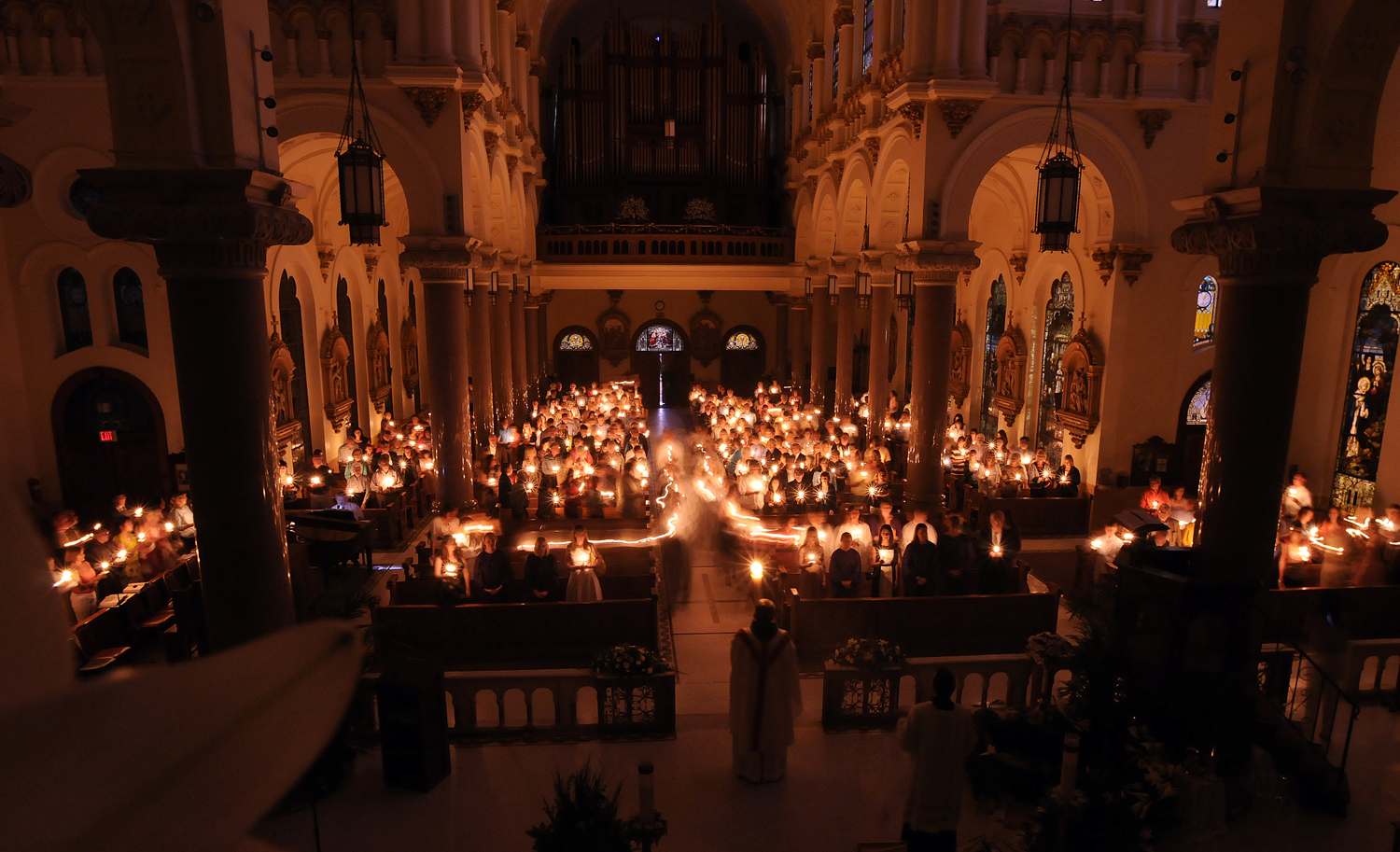
Darkness, Candles, and Things Unsaid

Easter Vigil at Sacred HeartI am always amazed at the sayings that are attributed to St. Francis of Assisi.  Today, I was asked if the following saying was from Francis: “All the darkness in the world cannot extinguish the light of a single candle.”  Nice, but at first blush it does not possess the language or sense of language for which Francis is known. The language is not even particularly medieval, but then maybe this is just a modernized version of the saint’s words.

If you search the internet, you will find this “quote” has pretty wide distribution and uniform attributed to St. Francis.  Most have no citation; but some do.  The only source given was “The Little Flowers of St. Francis.”  You can find the Little Flowers in volume 3 (pp. 566-658) of Francis of Assisi: Early Documents  –  Armstrong, Regis, J.A. Wayne Hellmann, and William Short, eds. (New York: New City Press, 1999–2004).

What you can’t find is the quote, or an account for which the quote could be a reduction. I could be wrong.  If someone has the specific citation (text and chapter) that would be an interesting thing to know.   I know I should just let these things go, but…. let the saint speak for himself … I’m just saying.