Racial Blues

In truth, I really could not think of a good title. But I guess that is OK. They aren’t my words. They point to the words of Fr. Bryan Massingale, a priest of the Diocese of Milwaukee and a professor of theology at Marquette University. Take five minutes and read his reflection on the trial of George Zimmerman for taking the life of Trayvon Martin.  “When profiling is “reasonable,” injustice becomes excusable”

And after reading his reflection, take a lifetime to reflect.

Mary Magdalene

Magdalene Penitent
Donatello
Museo dell’Opera del Duomo – Florence

Did you know that Mary Magdalene is mentioned 12 times in the gospels, more than most of the Apostles. She was present at the crucifixion and was the first witness to the Resurrection (John 20 and Mark 16:9). She was the “Apostle to the Apostles”, an honorific that St. Augustine bestowed upon her in the fourth-century, and possibly he was but repeating a moniker already in use.

Mary Magdalene has long been confused with other women in Scripture also named Mary as well as an anonymous women, the unnamed sinner (commonly thought to have been a prostitute) in Luke 7:36-50.  In time, the identities of all these women were conflated into one in the person of “Mary Magdalene, the repentant prostitute.” The first written evidence we have of this conflation  of Mary Magdalene being a repentant prostitute comes from Ephraim the Syrian in the fourth century. Continue reading →

Winner the Pooh, Rabbit, Martha and Mary

A Very Merry Pooh Year

Patrica Datchuck Sanchez had an interesting beginning to her commentary on the Martha and Mary story in Luke’s gospel:

Convinced that there is a discernible wisdom in A.A. Milne’s Winnie the Pooh (Dell Pub. Co., New York: 1926), I consulted the portly bear for a lesson in hospitality, the central theme of today’s first reading and gospel. Edward Bear, known to his friends as Winnie the Pooh, or Pooh for short, decided to visit Rabbit. As he drew nearer to Rabbit’s home, Pooh began to hum. “Aha”, he said, “Rabbit means Company and Company means Food and Listening-to-Me-Humming!” When he called out, “Is anybody at home?” he heard a scuffling noise and then silence. He called again, more loudly, “Is anybody home?” No!, said a voice and then added, “You needn’t shout so loud. I heard you quite well the first time!” “Oh, bother!” said Pooh. “Isn’t there anybody home at all?” The answer came back, “Nobody!”

There is, perhaps, at times, a little of Pooh and Rabbit in all of us. Pooh regarded hospitality as an opportunity for food, fun and attention. Rabbit saw it as a bothersome chore he’d rather forego.

Franciscan Rules

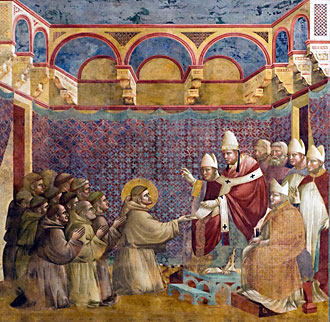
francis-innocentThe year is 1220 and Francis has just announced his decision to step down as “leader” of the Franciscan brothers.  In last week’s installment (Hierarchy of Authority – Hierarchy of Example), I described Francis’ reason for stepping down.  Francis had already seen the effects of a vacuum in spiritual authority brought about by his year-long absence while in the Middle East.  It is in leaving to his “vicar” and to the Roman Church the care of making decisions of a normative or disciplinary type that he could hope to preserve a superior authority, of a spiritual type, that would only have been diminished in the heat of daily administration. Continue reading →

Perusing Scripture

English: old greek papyrus

Greek papyrus (Photo credit: Wikipedia)

“Peruse” is an interesting word, according to Merriam-Webster it has an original meaning (15th century): to examine or consider with attention and in detail : study.  That makes sense given its derivative from Middle English in which “per” meant completely.  But “peruse” acquired a different meaning over time:  to look over or through in a casual or cursory manner.  Etymology studies only indicate the shift in meaning in the 20th century (some argue for 19th century) – not the reasons why.  If I had to offer an uninformed guess, it would be because the word sounds “casual” and so people, not realizing the actual meaning, began to use “peruse” in a different, almost opposite way from its original meaning. Words can be like that. Continue reading →

Rules

We are promised that whenever two or three are gathered in Jesus’ name, there He will be among us.  I have always suspected when the number is more than a billion world-wide, you better have rules. Rules are necessary – even helpful, but we always need to remember the basis of the rule or things get confusing when people interpret rules in differing ways. I suspect a lot of church arguments fall in this category. Believe it or not, the most common “church rule” question I receive is “how many times a day can I receive Eucharist.”  There is a set number and conditions – I will leave you the details to research on-line.  But when you find the rule (if you do) will you find the basis for the rule? Continue reading →

Martha and Mary

English: Johannes Vermeer's Christ in the Hous...

English: Johannes Vermeer’s Christ in the House of Martha and Mary (Photo credit: Wikipedia)

Luke 10:38-42 – Martha and Mary

16th Sunday in Ordinary Time

38 As they continued their journey he entered a village where a woman whose name was Martha welcomed him. 39 She had a sister named Mary (who) sat beside the Lord at his feet listening to him speak. 40 Martha, burdened with much serving, came to him and said, “Lord, do you not care that my sister has left me by myself to do the serving? Tell her to help me.” 41 The Lord said to her in reply, “Martha, Martha, you are anxious and worried about many things. 42 There is need of only one thing. Mary has chosen the better part and it will not be taken from her.” Continue reading →

St. Bonaventure

Saint Bonaventure

Saint Bonaventure (Photo credit: Wikipedia)

This Monday marks the Feast Day of one of the great figures in Franciscan history – St. Bonaventure of Bagnoregio – as well as the eighth anniversary of our Franciscan presence in this historic downtown parish.  St. Bonaventure is a good model of what it means to be a Franciscan, while at the same time being a priest in leadership positions in a parish.  Bonaventure reminded the friars of his day that our first vocation is as “brother.”  At the core of our charism, we are a fraternity in mission to the People of God striving to continue our Order’s 800-year-old mission:  bringing the Gospel into the everyday experience of men and women through our life in fraternity and compassionate service to all. Continue reading →

St. Bonaventure

This Monday marks the Feast Day of one of the great figures in Franciscan history – St. Bonaventure of Bagnoregio – as well as the eighth anniversary of our Franciscan presence in this historic downtown parish.  St. Bonaventure is a good model of what it means to be a Franciscan, while at the same time being a priest in leadership positions in a parish.  Bonaventure reminded the friars of his day that our first vocation is as “brother.”  At the core of our charism, we are a fraternity in mission to the People of God striving to continue our Order’s 800-year-old mission:  bringing the Gospel into the everyday experience of men and women through our life in fraternity and compassionate service to all.

Among our brother friars in Holy Name Province we have medical doctors, nurses, university professors, world renown artists, scholars, directors of nursing homes, youth ministers, teachers, butchers, bakers, cobblers, tailors, economists, HVAC mechanics, as well as men who serve as ordained ministers in parishes.  Bonaventure reminds us all that we are called to work, to live a common life in fraternity, and to give humble witness to those we serve.  Bonaventure himself gave continual witness to that humble service.

In the years while St. Francis was alive, the Franciscan Order experienced rapid growth – which only accelerated after St. Francis’ death and canonization – each friar and local fraternity trying to discern what it meant to follow Christ in the “tradition” of Francis of Assisi. They came to several differing conclusions and the opinions were not always offered “humbly.”  Over simply, one group called for poverty to be the mainstay while another called for obedience. A third group was in the middle just wanting everyone to get along because fraternity and minority were the hallmarks of Franciscan life. The Order was beginning to come apart at the core.

It was in the midst of this dissension that Bonaventure was elected to lead the friars during one of the most fractious times in the Order’s history.  In the following 15 years of leadership, Bonaventure continually visited the brothers – walking from Assisi, to Padua, to Madrid, to Paris, and to all the friaries of Europe.  His example of humble living coupled with his words reminding the friars that following Christ was the center of Francis’ vision, enabled the rifts in the fraternity to be healed.

His humble manner of living was on display when the Pope elevated him to the role of Cardinal.  The papal couriers carrying the official proclamation and “red hat” found Bonaventure at one of the friaries in northern Italy.  When the couriers arrived on the scene, Bonaventure, the Minister General of the Order, was occupied washing the dishes after a meal.  The courier’s formal announcement was followed by the presentation of the red hat.  Bonaventure thanked him, asked him to set the hat on the table, and said he would attend to those things as soon as he had finished washing the dishes.

The friars of Sacred Heart share this anniversary with St. Bonaventure, and so it is perhaps best to remember the words of St. Francis that Bonaventure quoted to his brothers during his days of leadership:  “Up to now we have done nothing.  Let us again set out to do that which we have been given.”

May we all bring the Gospel into the everyday experience of men and women through our life as a community and in compassionate service to all.

The choices we make

all-kinds-doorsThere was a time in the history of the Franciscans where we were a raucous, contentious, squabbling bunch – each group claimed to know St. Francis’ real intention about the way to follow Christ. The minister general of the day, St. Bonaventure, gathered the friars together- and like Moses, gave a sermon that was not too mysterious or too arcane. In a way, he simply told them that to truly follow the intention of St. Francis they had to choose. Choose what each friar would become as a result of their choices and, just as important, consider what the world becomes because of their choices. They were becoming a religious order noted for internal to fighting.  And because of it, the world was become darker because of their example of following Christ. Continue reading →