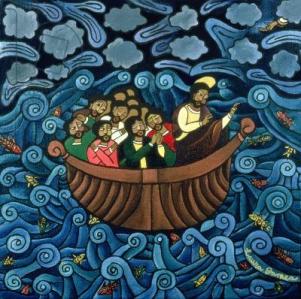
Storms in life

LJA130270The gospel for this coming Sunday, the 12th Sunday of Ordinary Time ( Year B), is the Markan account of the calming of the storm waters on the Sea of Galilee.

“On that day, as evening drew on, he said to them, “Let us cross to the other side” (Mark 4:35). As Stoffregen asks: Why do the disciples cross the lake? There are several possible answers: (a) to get to the other side or (b) as recorded in the text, Jesus told them to cross over. Even though (b) is the correct answer, (a) raises the curiosity: what is on the other side? Gentile (unclean) territory indicated by “unclean spirits,” “swine,” and “Decapolis.”  Many scholars hold that this trip across the lake represents the Gentile mission for Mark. The storm at sea represents the storms in the early church as they sought to carry out Jesus’ command “to go to the other side” or “to make disciples of all nations.” It may be noted that the area where the people of God sit while in church is properly called the “nave,” from the Latin “navis” = ship. Continue reading
An eye for an eye

jesus-teaching-mountIn today’s gospel from Mark, Jesus continues his discourse called the Sermon on the Mount. It is from a section of the Sermon which is marked with “you have heard it said… but I say to you…” He is not overturning the Ten Commandments and the Law of Moses, but rather he is commenting on their misunderstanding of God’ intent in the gift of the Covenant and the Law. Misunderstanding can be taken as “you have misunderstood all along and each generation just makes it worse” – or – Jesus is telling them to “take the next step in their evolution of understanding the mysteries of God’s intent.”

Continue reading

Who then is this?

storms-at-seaThe gospel for this coming Sunday, the 12th Sunday of Ordinary Time ( Year B), is the Markan account of the calming of the storm waters on the Sea of Galilee. This gospel account appears in the context of parables and miracles.

In 4:1-34 Jesus teaches in parables, which keeps those “outside” from understanding (4:11-12), but Jesus “Without parables he did not speak to them, but to his own disciples he explained everything in private.” (4:34). However, we will see that even with the special instructions, the disciples don’t get it. But parables are not the only method of teaching. In 4:35-5:43 Jesus teaches with miracle – stilling the storm (4:35-41); the demonic legion (5:1-20); raising Jairus’ daughter and healing the woman with a flow of blood (5:21-43 – the text for next week). However, following these displays of Jesus’ power, the responses are not positive: Continue reading

The Hamburger

Summer is upon us and with the pandemic receding in the rear view mirror (we pray!), it is time to turn our attention to backyard/rooftop/where-ever grilling. There are many topics for which refresher courses might be needed, but I would draw you attention to the post-grilling assembly of the hamburger. Is there a Best Order to Stack Hamburger Toppings? Think not? But perhaps you have experienced soggy buns, sub-optimal flavor melding, and, the just-ruined-my-shirt event: escaped toppings. Have a read and just maybe take a first step to improving the already great hot-off-the-grill hamburger experience.

Kingdom and Mystery

Kingdom_of_GodThe year was 1957. The “space-age” began when the Russians launched the Sputnik satellite into earth orbit. The same year General Motors produced the classic “57 Chevy” – more properly known as the Bel-Aire. It could be yours for $2,400. The price of a new home averages between $12,000 and $20,000.  You could rent a home for around $100/month. A week’s worth of groceries was under $20. Gasoline was about $0.24/gallon. A pack of cigarettes cost… well, that doesn’t matter, you shouldn’t be buying cigarettes anway. A top-named TV star was Roy Rogers (the cowboy, not the restaurant). Gunsmoke and Perry Mason were top-rated TV shows. Rock Hudson, John Wayne, Kim Novak, Marilyn Monroe, James Stewart – to name a few –  were the top stars in Hollywood. And here was the menu at McDonald’s: hamburgers: $0.15 ($0.19 for a cheeseburger) with french fries and drinks, $0.10 each. The year was 1957 and St. Francis of Assisi parish was founded in Triangle, VA.

Continue reading

Francis and the Crusades – Part 1

Crusade-battleOne of the events of Francis’ life that has received scant public attention was his meeting with the sultan of Egypt, Al-Malik al-Kamil in 1219 during the so-called “Fifth Crusade.” This meeting has loomed large in the imagination of the “Franciscan world” because of its effect on the Rule of Life and in the Franciscan charism of missions, but has only recently gained public attention because of the new era of tensions with the Islamic world.  People are surprised to learn that Francis was part of a crusade – a claim that scholars argue to no end as they argue so many other aspects of Francis’ life.  Each side has generally already taken a view of the little poor man from Assisi:  Francis the loyal churchman or Francis the radical reformer.  Those views are often revelatory of how the scholar views the Crusades.  And as with all things, history has a context.

Continue reading

Most Sacred Heart of Jesus

The Solemnity of the Most Sacred Heart of Jesus is a celebration that falls 19 days after Pentecost, on a Friday. The liturgical feast was first celebrated in Rennes, France. The liturgy was approved by the local bishop at the behest of St. John Eudes, who celebrated the Mass at the major seminary in Rennes on August 31, 1670. You’ll notice that the first celebration was not situated in the days following Pentecost. St. John Eudes composed a Mass and a set of prayers for outside the Mass (referred to as an “Office”) that were quickly adopted in other places in France.  Continue reading

Parables: final thoughts

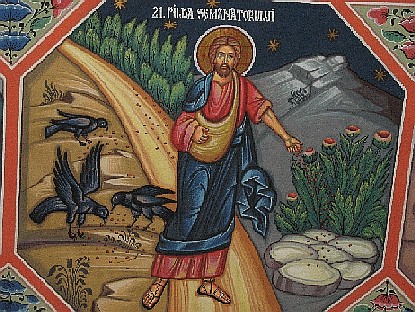
parable_SowerThis coming Sunday’s gospel ends: With many such parables he spoke the word to them as they were able to understand it. Without parables he did not speak to them, but to his own disciples he explained everything in private. (Mark 4:32-34) Mark concludes this collection of parables with a summary indicating  that he has selected illustrations of Jesus’ teaching from a much larger cycle of tradition. It was Jesus’ method to teach the people through parables such as the one which Mark has presented. Through these parables Jesus is proclaiming the good news of the Kingdom; in other words, He was proclaiming “the word.” The term is an echo of the explanation given to the parable of the sower, where it occurs eight times. It is appropriate to the vocabulary of revelation and means clearly “the word of God,” or more concretely “the word of the Kingdom.”

Continue reading

The Mustard Seed

parable_SowerThis coming Sunday’s gospel is the parable of the mustard seed. Of the three parables of seed which is sown this last is most elaborately introduced in explicit parabolic formulation: the Kingdom of God is like what happens to a grain of mustard. The mustard seed was proverbial in Jewish thinking as the smallest of all seeds. He said, “To what shall we compare the kingdom of God, or what parable can we use for it? It is like a mustard seed that, when it is sown in the ground, is the smallest of all the seeds on the earth. But once it is sown, it springs up and becomes the largest of plants and puts forth large branches, so that the birds of the sky can dwell in its shade.” (Mark 4:40-32)

Continue reading

The lens of Covenant

sermon-on-the-mountThe gospel text for this Wednesday of the 10th Week is take from the “Sermon on the Mount” in Matthew’s gospel: 

17 “Do not think that I have come to abolish the law or the prophets. I have come not to abolish but to fulfill.18 Amen, I say to you, until heaven and earth pass away, not the smallest letter or the smallest part of a letter will pass from the law, until all things have taken place.19 Therefore, whoever breaks one of the least of these commandments and teaches others to do so will be called least in the kingdom of heaven. But whoever obeys and teaches these commandments will be called greatest in the kingdom of heaven. (Matthew 5:17-19) 

Warren Carter (Matthew and the Margins) has these introductory comments about the entire sermon:  Continue reading