

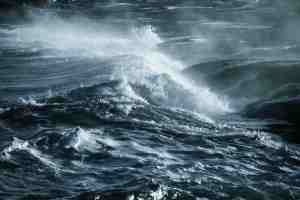
 The tempest rages, the crew prays, each to his own god, the cargo is being tossed overboard in an attempt to save the ship that is in danger of breaking up. Jonah is curled up in a corner below decks fast asleep.
6 The captain came to him and said, “What are you doing asleep? Rise up, call upon your God! Perhaps God will be mindful of us so that we may not perish.” (Jonah 1:6) Did the captain go looking for Jonah? I suspect not. I think he is below deck to see what other cargo can be tossed overboard when he stumbles upon Jonah asleep. Everyone else is working to save the ship, save themselves. The captain, exasperated shouts out “What are you doing asleep?” Seriously, dude, get your sorry self up and if you’re not going to lend a hand to help us, at least “call upon your God!” We’ve shot-gunned our prayers across a whole passel of gods seeing if we can appeal to the god behind this storm. “Perhaps God will be mindful of us so that we may not perish.” (Given that he is sea captain, there were no doubt some “salty” words mixed in the middle.) Continue reading
 Many folks I know have committed to read the entire Bible – an ambitious plan, but one I highly commend and recommend. For some, their plan was to begin at the beginning with Genesis and read straight through to Revelation. That would never be my recommendation. The Bible is not a novel that moves seamlessly from book to book. Rather it is a collection of books. The Genesis-to-Revelation plan has been written about in
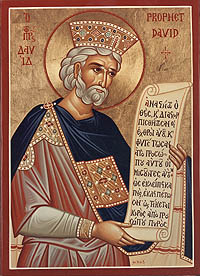 David, son of Jesse – the one who became King of Judah and Israel – anointed as a young lad, the one who defeated Goliath, the one who established Jerusalem as the holy city and brought the Ark of the Covenant to reside. King David of whom the Books of Kings and Chronicles hold up as favored of God, as the high-water mark of all the kings – it is his voice who cries out to the Lord. “A heart contrite and humbled, O God, you will not spurn” (Ps 51:19) Such is the refrain from the Responsorial Psalm from
 When last seen Jonah had booked passage for Tarshish in order to flee as far from God and the prophetic mission as possible. It certainly was his decision to make, but one of the points I believe the author is making is that our decisions are (a) never isolated from our other decisions, they form the path we walk, the character we are developing, and (b) never isolated from others. Consequences pour out from our choices into the lives of others. His personal choice leaves in place the wrecking ball of evil that is Assyria and Nineveh. He could choose to fulfill his mission and either (a) they are destroyed or (b) they repent. Either way the “wrecking ball” is out of action. But he is too self-centered, selfish to potentially sacrifice himself for the others, for the mission. And now he will drag others down by his choice to run.
 Several days ago I posted about the
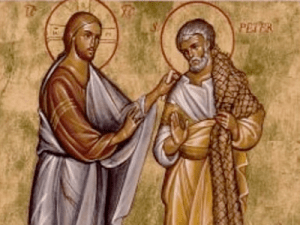 Most of the apostles and lots of saints have their own feast day, but there is no “Feast of St. Peter.” Today (February 22) the Church celebrates the “Chair of Peter” the sign that Peter was the first among the apostles and the one designated to lead the early Church after Jesus’ Resurrection and Ascension. For the record, Peter is not alone. St. Paul does not have a “Feast of St. Paul.” We celebrate these great saints together in a single celebration, the
 This is the word of the LORD that came to Jonah, son of Amittai” (Jonah 1:1)
 I suspect many readers will not recognize the name in the title. She passed away at age 62 on Friday. She was an Ursuline Sister, born in Colorado, raised in New Mexico, vowed in Kentucky, and served the Ursuline Sisters in Guatemala’s western highland during the years of that country’s civil war. She was an elementary school teacher. Please take a moment to read her

