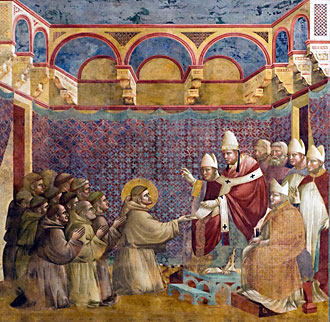
The year is 1221 and at the request of the “cardinal protector” of the friars, Cardinal Hugolino, Francis and several of his brothers have taken up the task of writing a formal rule of life. It was not clear that the Franciscans were actually a “religious order.” When Francis visited Pope Innocent III in 1209, the pope verbally approved (or did he?) a Rule of Life that was written down in few words. In 1216, the 4th Lateran Council ruled that no new religious orders could be formed: all new groups would be absorbed into existing religious orders. Hugolino recognized the uniqueness of the charism of St. Francis and his brothers and was determined that it not be lost to the church.
Francis and some companions undertook the writing of the “early rule” also known as the Rule of 1221. It is a potpourri of spiritual reflections, exhortations, and communal and individual norms of behavior – all animated by extensive citations from Scripture. Even though Francis was attempting to write a juridical rule of life that would “pass muster” from the canon lawyers in the Roman Curia, at the same time he was trying to write a rule borne out of his lived experience of following Christ and the pathway that was revealed to him: “God has called me to walk in the way of humility and showed me the way of simplicity. I do not want to hear any talk of the rule of Saint Augustine, of Saint Bernard, or of Saint Benedict. The Lord has told me that he wanted to make of me a new fool in the world, and God does not want to lead us by any other knowledge than that.” (Assisi Compilation, 18)
The rule was finished, shown to Hugolino (we do not know of his reaction), and submitted to the Roman Curia. We know the end result. There is a reason why the “early rule” or “Rule of 1221” is more formally known as the regula non bullata – it was rejected. But undaunted, Francis and his brothers rolled up their sleeves and went to work on a more streamlined rule, one more suited to the tastes of the canon lawyers. This “later rule” or “Rule of 1223” is known as the regula bullata because it was formally issued under the Papal Bull (seal) Solet annuere. It conferred on the Franciscans the official status of “Order” as a juridical foundation.
The document was the most the Curia would accept and was far less than Francis wanted, even if it remained faithful to his fundamental intuitions of the way of life God had showed to him. For the next three years of his life, Francis worked to continue to give example, a living testimony, of the manner and meaning of the approved rule – and at the end of his life Francis wrote his Testament, a clear indication of what Francis wanted for the order: live under the Rule of 1223 – but hold the Rule of 1221 close to your heart. Here is one example of the differences between the two rules:
|
Regula non bullata (1221)
Chapter 16: Those who are going among Saracens and other non-believers |
Regula bullata (1223)
Chapter 3: Of the Divine Office and fasting, and how the friars are to travel about the world |
| The Lord says: Behold, I am sending you as lambs in the midst of wolves. Therefore, be prudent as serpents and simple as doves (Mt 10:16). Therefore, any brother who, by divine inspiration, desires to go among the Saracens and other nonbelievers should go with the permission of his minister and servant. And the minister should give [these brothers] permission and not oppose them, if he shall see that they are fit to be sent; for he shall be bound to give an account to the Lord (cf. Lk 16:2) if he has proceeded without discretion in this or in other matters. As for the brothers who go, they can live spiritually among [the Saracens and nonbelievers] in two ways. One way is not to engage in arguments or disputes, but to be subject to every human creature for God’s sake (1 Pet 2:13) and to acknowledge that they are Christians. Another way is to proclaim the word of God when they see that it pleases the Lord, so that they believe in the all-powerful God—Father, and Son, and Holy Spirit—the Creator of all, in the Son Who is the Redeemer and Savior, and that they be baptized and become Christians; because whoever has not been born again of water and the Holy Spirit cannot enter into the kingdom of God (cf. Jn 3:5) There are 14 more lines- all scripture about mission. |
And this is my advice, my counsel, and my earnest plea to my friars in our Lord Jesus Christ that, when they travel about the world, the should not be quarrelsome or take part in disputes with words (cf. 2 Tim. 2:14) or criticize others; but they should be gentle, peaceful, and unassuming, courteous and humble, speaking respectfully to everyone, as is expected of them. … Whatever house they enter, they should first say, “Peace to this house” (Lk. 10:5), and in the words of the Gospel they may eat what is set before them (Lk. 10:8).
The differences are sometimes quite clear. In the 1223 Rule, one travels about the world while making sure that the Divine Office is prayed and proscribed fasts are observed – both worthy things. Only then is one to evangelize and be about mission – which has a certain logic and order to it all.In the 1221, the rules on prayer and fasting have their own section as foundational to being a friar, but the Rule holds up a model of minoritas and mission as intrinsic to the friar way of life. It is in this Rule that one sees the passion and soul of St. Francis and his attempt to describe the vision God has shown him. Especially prominent is mutual discernment between one brother and his community about God’s call. |
The Rule of 1221 and the Testament, even though not juridically approved, reveal the soul and passion of St. Francis, and as such are the “go to” texts when Franciscans study what it means to be “friar minor.”

 Act 1 – The Tableau