While Francis Was Away…

saint-francis-of-assisi-cimabueIn our previous three articles we described Francis’ part of the 5th Crusade and his meeting with the Sultan of Egypt, Al-Malik al-Kamil.  We know that Francis was away at a time when the community began to grow rapidly – and not just around Assisi, but in many other parts of Italy, Spain, France, and the Germanic nations as well.  While Francis was away, what happened to the friars he left behind?

Francis had delegated his powers to two vicars during his absence:  Matthew of Narni, who remained in Assisi, and Gregory of Naples, who visited the communities throughout Italy.  Another friar, Phillip the Tall, was entrusted with the care of St. Clare and her sisters, the Poor Ladies of San Damiano.  They were given very few orders or instructions.  This might seem odd, given that religious life in the 13th century was quite ordered and obedience was a topic often written about – even by Francis himself.  However, the friars were not technically an ordo, a religious order – they were still a “religious movement” – albeit, a quite famous and rapidly growing one that had the attention of the Pope and the Roman Curia – both in praise and concern. Continue reading →

St. Anthony of Padua – part 4

anthony-padua2Miracles and Traditions of St. Anthony. St. Anthony Bread is a term used for offerings made in thanksgiving to God for blessings received through the prayers of St. Anthony. Sometimes the alms are given for the education of priests. In some places parents also make a gift for the poor after placing a newborn child under the protection of St. Anthony. It is a practice in some churches to bless small loaves of bread on the feast of St. Anthony and give them to those who want them.

Different legends or stories account for the donation of what is called St. Anthony Bread. By at least one account it goes back to 1263, when it is said a child drowned near the Basilica of St. Anthony, which was still being built. His mother promised that if the child was restored to her she would give for the poor an amount of corn equal to the child’s weight. Her prayer and promise were rewarded with the boy’s return to life. Continue reading →

St. Anthony of Padua – part 3

tn_anthony-padua1Public Preacher, Franciscan Teacher. Anthony’s superior, St. Francis, was cautious about education such as his protégé possessed. He had seen too many theologians taking pride in their sophisticated knowledge leading to an abandonment of their commitment to a life of real poverty. In Anthony, however, he found a kindred spirit for his vision, who was also able to provide the teaching needed by young members of the order who might seek ordination. Francis wrote in 1224, “It pleases me that you should teach the friars sacred theology, provided that in such studies they do not destroy the spirit of holy prayer and devotedness, as contained in the Rule.” He thereby entrusted the pursuit of studies for any of his friars to the care of Brother Anthony. From then on his skills were used to the utmost by the Church. Occasionally he took another post, as a teacher, for instance, at the universities of Montpellier and Toulouse in southern France, but it was as a preacher that Anthony revealed his supreme gift. Continue reading →

St. Anthony of Padua – part 2

tn_anthony-padua1Before He Was Anthony of Padua.  Anthony of Padua was born Fernando Martins de Bulhões on August 15, 1195 in Lisbon, Portugal. His was in a very rich family of the nobility who wanted him to become educated, and they arranged for him to be instructed at the local cathedral school. Against the wishes of his family, however, at the age of 15 he entered the community of Canons Regular at the Abbey of St. Vincent on the outskirts of Lisbon. Monastery life was hardly peaceful for young Fernando, nor conducive to prayer and study, as his old friends came to visit frequently and engaged in vehement political discussions. Continue reading →

St. Anthony of Padua – part 1

tn_anthony-padua1For more than 100 years, Sacred Heart Catholic Church (in downtown Tampa, FL) had been under the pastoral guidance of the Jesuits. When we Franciscans arrived at Sacred Heart in 2005, we were quite surprised to find that one of the clerestory windows (the ones up high in the nave vault) was Saint Anthony of Padua, a Franciscan contemporary of St. Francis of Assisi.  In fact, we Franciscans still have a brief letter, in Francis’ own hand, written to Anthony. Most people know St. Anthony of Padua as the patron saint of lost and stolen articles, but have you ever wondered why he is that particular patron saint?

The Patron Saint of Lost Things. The reason for invoking St. Anthony’s help in finding lost or stolen things is traced back to an incident in his own life. As the story goes, Anthony had a book of psalms that was very important to him. You have to remember this was before the age of the printing press and so all books were of great value, and besides the value of the book, the psalter had the notes and comments he had made to use in teaching students in his Franciscan Order.

A novice who had already grown tired of living religious life decided to depart the community. Besides going AWOL, he also took Anthony’s psalter! Upon realizing his psalter was missing, Anthony prayed it would be found or returned to him, and after his prayer the thieving novice was moved to return the psalter to Anthony and to return to the Order, which accepted him back. Legend has embroidered this story a bit. It has the novice stopped in his flight by a horrible devil, brandishing an ax and threatening to trample him underfoot if he did not immediately return the book. Obviously a devil would hardly command anyone to do something good, but the core of the story would seem to be true. The stolen book is said to be preserved in the Franciscan friary in Bologna.

In any event, shortly after his death people began praying through Anthony to find or recover lost and stolen articles. And the “Responsory of St. Anthony” composed by his contemporary and brother friar, Julian of Spires, proclaims, “The sea obeys and fetters break/And lifeless limbs thou dost restore/While treasures lost are found again/When young or old thine aid implore.”

Francis and the Crusades – Part 3

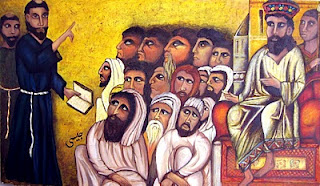
francis-sultanIt is important to recognize why Francis came to Damietta during the Fifth Crusade is just one part of his life.  How the experience of the crusade and his meeting with the Sultan of Egypt, Al-Malik al-Kamil, may have changed Francis is a different part of the saint’s life.  While the early sources about the life of Francis are uniform in Francis’ zeal for evangelization and his desire for martyrdom, many modern scholars dismiss these as hagiographic (“saint making”) embellishments.  The modern desire, especially among Franciscan scholars, seems to ensure that Francis “the peacemaker” arrives on the shore of Egypt in 1201.  When one looks outside modern Franciscan scholarship, especially to the current medieval specialist, one gains a different perspective.  André Vauchez, a French medievalist noted for his recent and thorough book on Francis, thinks that “some commentators are doubtful today [re: martyrdom], fearing to attribute to their hero a suicidal attitude or irresponsible behavior.”  Vauchez goes on to write, that “Contrary to what is sometimes affirmed, the search for martyrdom was not in contradiction with his desire to follow Christ, who died on the cross to open to humanity the way to salvation.  To face tribulations and dangers, including the loss of life, in order to spread the Christian faith was, from the beginning, a constitutive element of Franciscan sensibility.” Continue reading →

Francis and the Crusades – Part 2

crusaders2The previous two articles give the background for Francis of Assisi’s mission during the time of the Fifth Crusade.  The previous article introduced two key ideas that seemed to be part of a strong spiritual movement in Francis’ time: peregrination pro Christo (“wandering for the sake of Christ”) which we would now call “pilgrimage,” and the long-established idea of Christian martyrdom.  We have already seen the friars “wandering for Christ” in their trips throughout central Italy. Continue reading →

Francis of Assisi – to this point….

Some folks have asked for an updated page for all the articles on St. Francis of Assisi – so here is what we have “to this point.”

Francis of Assisi – An Introduction
Francis of Assisi – The Young Man
Francis of Assisi – Military Adventures
Francis of Assisi – Period of Crisis: San Damiano
Francis of Assisi – Period of Crisis: Leaving the World
Francis of Assisi – Period of Crisis: Embracing the Leper
Francis of Assisi – “And the Lord gave me brothers…”
Francis of Assisi – The Fraternity Grows and Someone Has to Lead
Francis of Assisi – An Exhortation to the Brothers
Francis of Assisi – The Itinerant Life of the Brothers
Francis of Assisi – The Disposal of Worldly Goods
Francis of Assisi – The Conversion of Clare
Francis of Assisi – A Reputation for Holiness and Miracles
Francis of Assisi – The Problems of New Growth
Francis of Assisi – Francis and Nature: Part I
Francis of Assisi – Francis and Nature: Part II
Francis of Assisi – A Sacramental View of Nature
Francis of Assisi – Francis and The Eucharist
Francis of Assisi – Integrating Into the Church
Francis of Assisi – The Word of God
Francis of Assisi – The First Missions
Francis of Assisi – The Crusades (Part 1)

Francis of Assisi – The First Missions

Francis-missionsAn earlier article had discussed the problems with the rapid growth of members within in the fledgling community friars.  The period from 1213 to 1216 is the most obscure period in Francis’ life and also one of the periods of explosive growth in the movement as the brotherhood spread well beyond Assisi.  How many friars joined the fraternity in those years?  It is impossible to say, but we do know this: in 1217 the annual meeting (called a “chapter”) made the decision to send out missions across the Alps into northern Europe, the Baltic states, and to the Crusader States in the eastern Mediterranean.  Within Italy, six provinces were established; outside of Italy, five provinces were established: Spain, northern and southern France, Germany, and Syria. Continue reading →

Francis and the Crusades – Part 1

Crusade-battleOne of the events of Francis’ life that has received scant public attention was his meeting with the sultan of Egypt, Al-Malik al-Kamil in 1219 during the so-called “Fifth Crusade.” This meeting has loomed large in the imagination of the “Franciscan world” because of its effect on the Rule of Life and in the Franciscan charism of missions, but has only recently gained public attention because of the new era of tensions with the Islamic world.  People are surprised to learn that Francis was part of a crusade – a claim that scholars argue to no end as they argue so many other aspects of Francis’ life.  Each side has generally already taken a view of the little poor man from Assisi:  Francis the loyal churchman or Francis the radical reformer.  Those views are often revelatory of how the scholar views the Crusades.  And as with all things, history has a context.

Continue reading →