
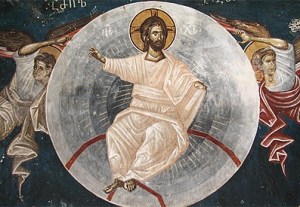
 The Church’s Mission Begins. Luke begins Acts as he began his Gospel, with a foreword to his patron Theophilus, reminding him that the “first book” covered the time until Jesus was taken up by God to heaven. The Gospel ends with a brief reference to this incident (Luke 24:51), which was preceded by important teaching given by Jesus to his disciples. So important was this teaching that we have three accounts of it. Luke records it in the Gospel (Luke 24, especially verses 44–49); he then summarizes it briefly in this introductory part of Acts, and then he covers certain aspects of it once again in the story of the ascension which is the first incident in the main narrative in Acts (1:6–11). The repetition is partly for emphasis, and at the same time it indicates that the period from Easter Sunday to the Ascension is both the conclusion of the earthly ministry of Jesus and the beginning of the work of the church. This period had two important characteristics. It provided evidence that Jesus was alive (1:3),, having risen from the dead, and it was the time when Jesus gave his mission orders to the apostles (1:4f.; cf. 1:7f.). Continue reading
Ascension: mission
Reply
 Memory is an interesting thing. There are many physiological and psychological theories around the topic, but lots of folks seem to agree we have memory for facts and memory for context. Sometimes the memories are general and sometimes explicit. We tie memory to specific events, personal experiences, semantic categories and more. Then whatever the memory, we have to “register” the memory, store it and then recall it.
  Several weeks ago I wrote “Not yet…” an article that acknowledged Pope Francis’ new apostolic exhortation, the Joy of Love – and noted that I was glad people were asking me about it, but I needed time to read it, re-read it, and think about it. I can report that I have now read it, have re-read parts of it, and am still thinking about. What I can offer at this point is some thoughts from here and there – and offer them cautiously at that.
  Perhaps it best not to translate the Greek word paraclete because there are too many possibilities. While the literal meaning of the related verb (parakaleo) means “to call to one’s side,” usually asking the other for help, the noun took on a legal meaning as “helper in court”. Thus we have translations like “counselor,” “advocate,” or “one who speaks for another” as well as the too general translation of “helper”.
  As I have loved you, so you also should love one another (John 13:34)
 It is said that you can tell a lot about a person by their hands. The common wisdom is that a person’s self-image is revealed in the manner in which they shake hands. One of the oft-told stories in my family is when my then college-aged niece brought home a young man to meet the family and her grandmother. We were all greeted by the “dead-fish handshake,” a weak hello, and eyes cast to one side. The family advice was uniform: dump him. My niece thought we were all a bit judgmental. Perhaps, but let’s just say it was an occasion where experience met prudence. The handshake told us almost everything we needed to know. Several weeks later, our niece came to the same assessment.
  friarmusings