Bread of life: context

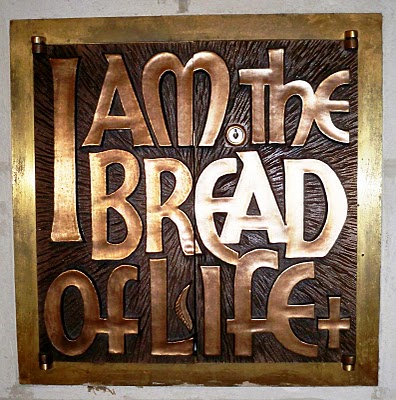
bread-of-life-tabernacle41 The Jews murmured about him because he said, “I am the bread that came down from heaven,” 42 and they said, “Is this not Jesus, the son of Joseph? Do we not know his father and mother? Then how can he say, ‘I have come down from heaven’?” 43 Jesus answered and said to them, “Stop murmuring among yourselves. 44 No one can come to me unless the Father who sent me draw him, and I will raise him on the last day. 45 It is written in the prophets: ‘They shall all be taught by God.’ Everyone who listens to my Father and learns from him comes to me. 46 Not that anyone has seen the Father except the one who is from God; he has seen the Father. 47 Amen, amen, I say to you, whoever believes has eternal life. 48 I am the bread of life. 49 Your ancestors ate the manna in the desert, but they died; 50 this is the bread that comes down from heaven so that one may eat it and not die. 51 I am the living bread that came down from heaven; whoever eats this bread will live forever; and the bread that I will give is my flesh for the life of the world.” (John 6:41-51) Continue reading

Good things and best things

snickersA few Super Bowls past, Snickers candy bars began a clever ad campaign. One ad showed 4 people in a car driving through desert landscape. Three of the people were young men in their 20’s, but the fourth was a high maintenance complaining passenger (played by Aretha Franklin) who was moaning about everything – “Can you turn up the AC? I’m dying back here.” When a passenger in the front tells them that the AC is on high, “Can’t you feel it?” He is rewarded with a smack on the back of the head, “Can you feel that?” The backseat companion encourages the complainer to eat a snickers because “When you’re hungry you turn into a diva.” After eating a Snickers candy bar provided by the concerned friend, the diva is transformed back into themselves and indicates that they are “better” …. But still their old selves, just one not complaining at the moment. Continue reading

Something about angels

City-of-Angels2I think most people know that the expression, “City of Angels”, refers to Los Angeles, CA. But did you know that the name is only the shortened form of the original city name, which grew up around one of the Franciscan missions? The original name of the pioneer town was, “El Pueblo de Nuestra Señora la Reina de los Ángeles de Porciúncula,” (in English, “City of Our Lady the Queen of Angels of the little Portion”). Both “Our Lady Queen of the Angels” and “the little Portion” are steeped in the earliest history of the Franciscan Order. For that we return to the 13 th century and the life of St. Francis of Assisi. Continue reading

Down from heaven: living bread

Bread-of-Life-John-6Comes Down from Heaven. 32 So Jesus said to them, “Amen, amen, I say to you, it was not Moses who gave the bread from heaven; my Father gives you the true bread from heaven. 33 For the bread of God is that which comes down from heaven and gives life to the world.” 34 So they said to him, “Sir, give us this bread always.” 35 Jesus said to them, “I am the bread of life; whoever comes to me will never hunger, and whoever believes in me will never thirst.

At vv.12 and 27 (gathering the fragments after feeding the crowd and referencing perishable food), Jesus implicitly linked the feeding miracle with the manna story of Exodus 16. In v.32, he does so explicitly. For the second time in this chapter Jesus prefaces his remarks with the solemn, Amen, amen, I say to you. Jesus reworks four essential elements of v. 31: Continue reading

Down from heaven: challenge

Bread-of-Life-John-6The Challenge.30 So they said to him, “What sign can you do, that we may see and believe in you? What can you do? 31 Our ancestors ate manna in the desert, as it is written: ‘He gave them bread from heaven to eat.’”

Throughout vv. 27–31, Jesus and the crowd use the same words but with very different meanings, another instance of the Johannine literary technique of misunderstanding. The crowd’s questions in v. 30 repeat key words from vv. 26–29: “sign” (sēmeion, v. 26), “do” (poieō, v. 28), “see” (eidete, v. 26, idōmen, v. 30), “believe” (pisteuō, v. 29), “work” (ergazomai, vv. 27–28). They shift the burden of who is to work from themselves (vv. 27–29) to Jesus (v. 30). The crowd’s questions imply a contingency: They will do God’s work only if Jesus does God’s work first and performs a sign. Continue reading

Down from heaven: working

Bread-of-Life-John-6For What Are You Working? 27 Do not work for food that perishes but for the food that endures for eternal life, which the Son of Man will give you. For on him the Father, God, has set his seal.” 28 So they said to him, “What can we do to accomplish the works of God?” 29 Jesus answered and said to them, “This is the work of God, that you believe in the one he sent.”

A modern reader might be more prone to take the beginning part of v.27 for exactly what it implies: don’t work; it will be given to you – the implication being, given as a gift – and more than that the given (Jesus) has been ordained/sealed for this purpose. But then the one who are hearing these words receive them in a difference context. These are working people for whom there is family and tradition – these are gifts – everything else is earned. The crowd gives “work” (ergazomai) a new meaning. Jesus’ admonition about laboring to receive a gift of imperishable food is transformed by the crowd into a question about their performance of works. The grace in Jesus’ words disappears. Continue reading

Down from Heaven: looking

Bread-of-Life-John-6Why Are You Looking? 24 When the crowd saw that neither Jesus nor his disciples were there, they themselves got into boats and came to Capernaum looking for Jesus. 25 And when they found him across the sea they said to him, “Rabbi, when did you get here?” 26 Jesus answered them and said, “Amen, amen, I say to you, you are looking for me not because you saw signs but because you ate the loaves and were filled.

The implication of the narrative is the crowd who finally caught up with Jesus in Capernaum could not have known about the miraculous events (vv.16-21) of the evening nor would they have had an opportunity to react to the ego emini statement – to even ponder, “Who is this that calms the sea.” Their last encounter with Jesus was at the miraculous feeding of the 5,000 and their desire then was to take Jesus by force and make him kind. It is at this point Jesus withdrew from them as the people wanted to remake the Messiah in their own conception. Jesus would not allow that; perhaps Jesus does not want to be found by the crowd “looking for Jesus.Continue reading

Down from Heaven: context

Bread-of-Life-John-624 When the crowd saw that neither Jesus nor his disciples were there, they themselves got into boats and came to Capernaum looking for Jesus. 25 And when they found him across the sea they said to him, “Rabbi, when did you get here?” 26 Jesus answered them and said, “Amen, amen, I say to you, you are looking for me not because you saw signs but because you ate the loaves and were filled. 27 Do not work for food that perishes but for the food that endures for eternal life, which the Son of Man will give you. For on him the Father, God, has set his seal.” 28 So they said to him, “What can we do to accomplish the works of God?” 29 Jesus answered and said to them, “This is the work of God, that you believe in the one he sent.” 30 So they said to him, “What sign can you do, that we may see and believe in you? What can you do? 31 Our ancestors ate manna in the desert, as it is written: ‘He gave them bread from heaven to eat.’” 32 So Jesus said to them, “Amen, amen, I say to you, it was not Moses who gave the bread from heaven; my Father gives you the true bread from heaven. 33 For the bread of God is that which comes down from heaven and gives life to the world.” 34 So they said to him, “Sir, give us this bread always.” 35 Jesus said to them, “I am the bread of life; whoever comes to me will never hunger, and whoever believes in me will never thirst. (John 6:24-35) Continue reading

Caring enough…

Rescued_LogoIf you have read this column long enough you will know that I am given to wandering about the landscape of any variety and manner of things that catch my interest. One of my most recent wanderings was back to the world of Science Fiction. As you might have gathered from last week’s column and its reference to Isaac Asimov’s “Robot Novels,” there was a time when I could have rightly been called a “fanboy” for all things science fiction. At one point in time my library was filled with the works of John W. Campbell, Arthur C. Clarke, Isaac Asimov, Frederik Pohl, Robert A. Heinlein, Ray Bradbury, Ursula K. Le Guin, Frank Herbert, and others. If you are familiar with the genre, you might notice this is an “old school” list. As time went on, there was less science, fantasy and, things-magical dominated the market niche. The quality of writing seemed to wane with the passing of the greats. My reading interests moved on to other works and other sensibilities. Looking back on it all, I think another reason was that the characters began to resemble action figures more so than human beings. I began to not care about the people in the story. Continue reading

Knowing Jesus: reflection

John 6+crowd+feedingAs noted in the Context section, our verses are followed by the Johannine account of Jesus walking on the water and calming the seas (John 6:16-21). Whereas the miraculous feeding miracle was performed before the crowds, this miracle is with the disciples alone. It is with that context that I offer Gail O’Day’s reflection [597-98]. Continue reading