
Overview
Opposed amphibious landings are difficult to say the least. Later this week we will remember the Normandy landings of June 6, 1944 which were, and remains, the largest amphibious invasion in history. The Allied Forces under the central command of General Dwight D. Eisenhower deployed nearly 7,000 naval vessels, over 11,000 aircraft, and enormous logistical support systems. The naval force included battleships, cruisers, destroyers, troop transports, and specialized landing craft. Over the course of the day more than 165,000 troops landed at five different beaches. Resistance ranged from intense at Omaha Beach to minimal at Utah Beach. This was made possible by complete domination of the sea and air – and a massive prepared logistic system in support from D-Day onward.
An opposed amphibious landing by China against Taiwan will be on the same order of magnitude. – and the Chinese have been practicing in plain sight for more than a decade.
This post describes the World War II logistic efforts to give the reader a sense of scope and complexity. The post goes on to describe China’s preparation for a potential amphibious landing. There are parallels to Normandy and there are massive differences.
D-Day at Normandy.
The landings were successful and then the logistic war needed to be won. The 165,000 soldiers needed to be resupplied with food, ammunition, and replacement soldiers. Heavy equipment such as artillery, tanks, trucks, etc. needed to be brought ashore. The inventory of what was needed to supply this massive invasion force is epic – and there were no ports, piers, heavy lift cranes/capacity and all the equipment that make up modern harbors. The Allies needed BYOH – bring your own harbors. And that is exactly what they did: the Mulberry Harbors.
Mulberry harbours were two massive, prefabricated portable harbours designed by the British in World War II to supply Allied forces on the open beaches of Normandy immediately following the D-Day landings. Components were built in the UK in great secrecy and towed across the English Channel, featuring breakwaters made of concrete caissons and sunken ships to combat storms and the harsh seas of the English Channel. Within the breakwaters the Mulberrys featured floating roadways supported by pontoons connected to massive floating pierheads that adjusted to the tidal changes.
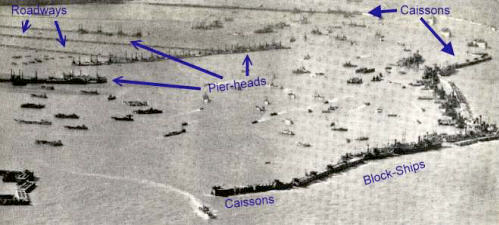
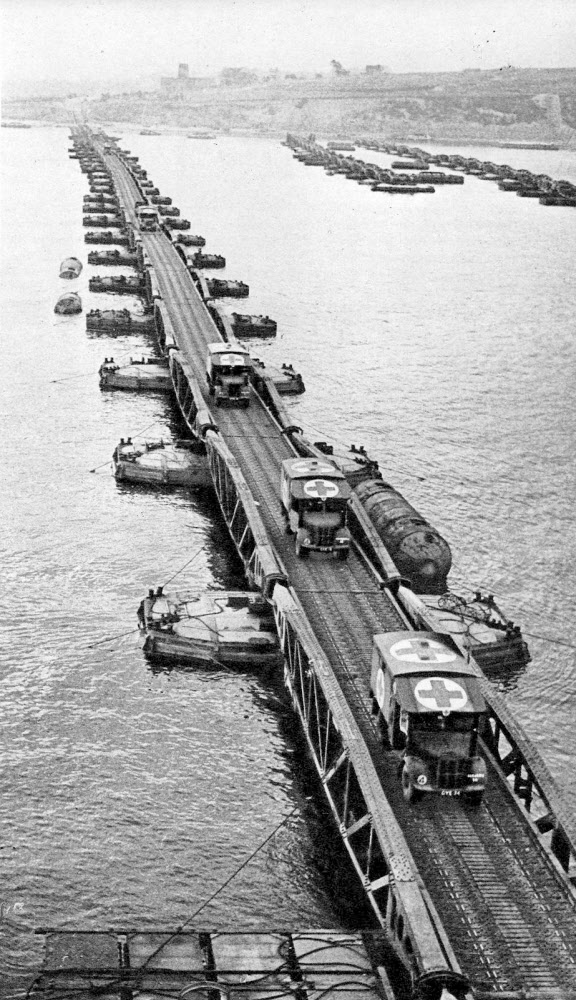
Normandy Mulberry Harbor and a Roadway
The vastness of the operation and the absolute necessity to move men, supplies, munitions and equipment to the right place at the right time are way beyond the logistics faced by the largest supermarket chains. It has been calculated that each soldier needed 6.5lb per day to sustain him in the field. On this basis the initial landing force needed 1,072,500 lbs per day – and that was just the initial landing force. As the size of the invading force grew, so did the daily demand for supplies. In addition, there were trucks, tanks, artillery pieces, ammunition, military field hospitals, mobile radar and communications units etc, etc. all of which had to be transported across the English Channel. More than 4,000 ships operated daily to provide the supplies.
Mulberry A at Omaha was destroyed by a massive English Channel storm 2 weeks after the landings. Mulberry B was used until the ports of Cherbourg and Antwerp became available.
Anyone wondering what an invasion of Taiwan might look like now has a fresh visual clue. Defence analysts watching Chinese shipyards have noticed an increase in a particular type of vessel. China has rapidly developed specialized large-scale landing platforms, known as Shuiqiao-class barges (Type 071or Landing Platform Utility – LPU), designed for an invasion of Taiwan. Sighted in early 2025, these vessels can connect in strings of three, totaling over 820 meters (2,690 ft) in length to create massive temporary, floating piers for landing tanks and heavy military equipment directly on beaches. In the picture below, the orange capped vertical appendages are jack-up legs that extend down to anchor on the bottom specifically for stability against tides and currents as it lifts up the craft at the same time. These self-propelled landing platform utility (LPU) barges have telescoping Bailey bridges that produce a relocatable pier. There is no obvious commercial use case for these vessels. They are rather dedicated platforms for landing on beaches to deliver high volumes of wheeled and tracked military vehicles, together with associated personnel and material.
China has modified large commercial civilian roll-on/roll-off ferries to transport troops and armored vehicles to the beaches. The Shuiqiao barges will likely serve as landing platforms for these vehicles.
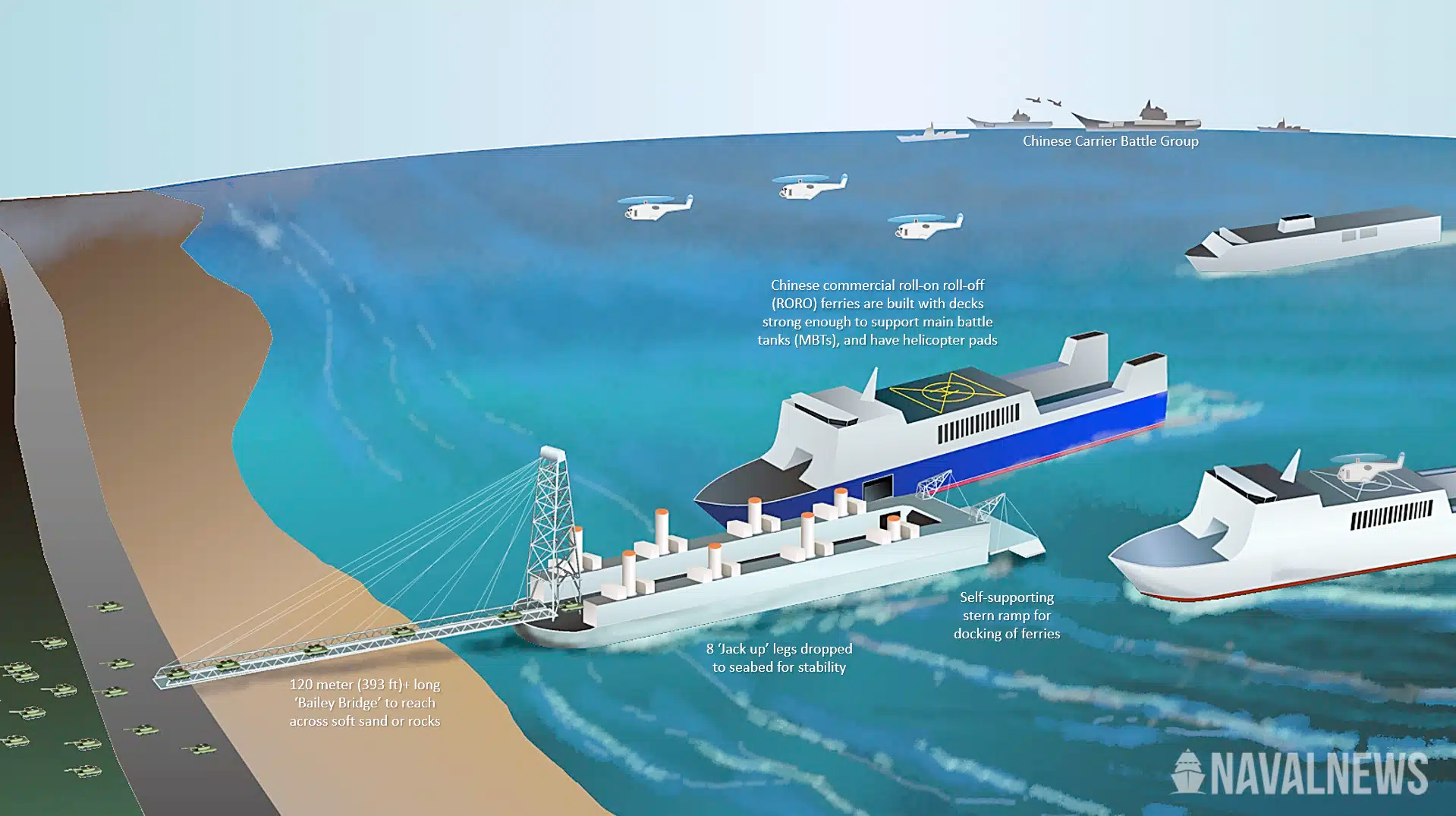
This article draws on the leading extant analysis, published by J. Michael Dahm and Thomas Shugart through the Naval War College’s China Maritime Studies Institute (CMSI)
Shuiqiao LPU, like the PLA-controlled ferries that would feed military vehicles through them, are not designed to be used during the initial assault phase against an opposing force, but rather as logistics support for second reinforcements. Like the Mulberrys, because of their vulnerability, they would be best employed only after a beachhead lodgment has been secured, in locations where the PLA Army and/or Marines already had solid, if not complete, control. To land the Shuiqiaos at an acceptable risk of loss, China’s military forces would first have to suppress Taiwanese defenders’ indirect and direct fire systems.
Expanded Amphibious Warfare Exercises
In August 2025, the People’s Liberation Army (PLA) troop and naval units conducted a large-scale exercise to simulate an invasion of Taiwan. This “capstone” amphibious exercise suggests that PL training and preparations for a future Taiwan campaign are becoming more focused, realistic, and sophisticated. The following information is taken a U.S. Naval War College China Maritime Report #52: Everything Everywhere All At Once: The Growing Complexity of PLA Amphibious Exercises.
“There has been much public discussion in recent years surrounding the PLA’s amphibious transport “gap” and China’s supposed inability to sustain a large-scale amphibious invasion of Taiwan. This discourse seems to have ignored the Chinese Communist Party’s decades-long strategy to obscure, obfuscate, and otherwise minimize its military intent and operational capabilities, hiding them from both the Chinese public and the international community. Satellite imagery reveals that in August 2025, the PLA executed a large-scale “capstone” amphibious exercise along China’s southeastern coastline, rehearsing an invasion of Taiwan. This exercise suggests that PLA training and preparations for a future Taiwan campaign are becoming more focused and sophisticated.”
Main Findings
- The exercise consolidated elements from previous years into a single simulated operation. It integrated a floating causeway system, anti-landing barriers and obstacles, and amphibious Landing Craft Tank (LCT) vessels that landed forces directly onto beachheads.
- For the first time observed, the PLA conducted a phased exercise with simultaneous amphibious landings in three distinct locations. Exercise areas incorporated civilian aquaculture obstacles like those expected to be found along Taiwan’s coastline, increasing environmental and tactical realism.
- The exercise occurred at simulated “landing locations” opposite Taiwan, particularly within the Zhangzhou-Xiamen-Quanzhou littoral zone. The locations were distributed at distance intervals comparable to likely wartime beachheads along Taiwan’s western coastline. The total distance between discrete exercise locations was approximately 360 kilometers, roughly the distance between Taipei and Kaohsiung.
- Not merely hypothetical in nature, the exercise reflected a specific geographical and operational focus. It appears to be part of a larger trend whereby the PLA is mapping its exercises onto analogous geography that reflects envisioned targets.
- Future research should explore the potential applications and implications of PLA efforts to train with similar distances and geometries as would be found in prospective conflict zones.
- Starting this summer, observers should scrutinize future capstone amphibious exercises to better understand the PLA’s strengths, weaknesses, and underlying operational assumptions.
Overall, the 2025 capstone exercise demonstrated meaningful progress toward the PLA’s ability to coordinate large-scale, dispersed amphibious operations using civil-military assets. The PLA probably leverages commercial, dual-use vessels to minimize its military logistics “signature” and can be expected to muster invasion forces in multifarious civilian ports. By intentionally blurring the line between civilian and military activity, the PLA raises uncertainty and increases the cost and effort of U.S. and Taiwanese monitoring, requiring additional sensors and analysts to interpret activity. The deployment of dual-use vessels obfuscates the PLA’s intentions, reduces indications and warning, and minimizes the amount of “executive decision time” available to non-PRC military and civilian officials prior to conflict, thus maximizing the probability of surprise.
The exercises also reinforce a broader trend: China is steadily moving from a coastal-defense navy toward a force capable of large-scale joint expeditionary and amphibious operations supported by immense commercial sealift capacity and rapidly expanding naval shipbuilding.
Operationally, the exercise makes sense within current PLA doctrine. Chinese planners increasingly appear interested in:
- distributed amphibious entry points,
- seizure of ports and airfields,
- vertical helicopter envelopment,
- and rapid inland penetration rather than a purely linear Normandy-style beach assault.
Multiple simultaneous landing zones could:
- dilute Taiwanese defensive concentration,
- create confusion about the main effort, and
- accelerate operational collapse if successful.
The four-location concept is particularly notable because it suggests the PLA is practicing operational dispersion and synchronization at scale. Such operations would require:
- advanced command-and-control,
- very large amphibious logistics capacity,
- secure communications,
- coordinated naval and air cover,
- and the ability to sustain forces ashore rapidly after initial landings.
It also highlights the importance of China’s growing fleet of Type 071 amphibious transport docks, Type 075 amphibious assault ship vessels, civilian roll-on/roll-off ferries, and large commercial sealift assets developed under China’s military-civil fusion strategy.
A closing thought
“Amphibious operations are among the most complex in modern warfare. They require effective command and control to synchronize an almost endless number of subcomponents into an effective whole. By increasing its flexibility and proficiency across relevant skill sets over time, the PLA is increasing the likelihood that it views (or will soon come to view) its ability to conduct a successful amphibious invasion of Taiwan as a viable option. The 2025 capstone exercise was conducted along the Zhangzhou-Xiamen-Quanzhou corridor, which closely matched the scale, spacing, and distances of plausible Taiwan invasion beachheads. Approximately 360 kilometers separated operational nodes in the exercise—comparable to the full north-south span of Taiwan’s western coastline. This scenario-specific rehearsal suggests the PLA is aligning its exercise designs with envisioned operational objectives, using geography and scale to refine campaign execution and facilitate its potential real-world application.” (CSMI Report #52)
 friarmusings