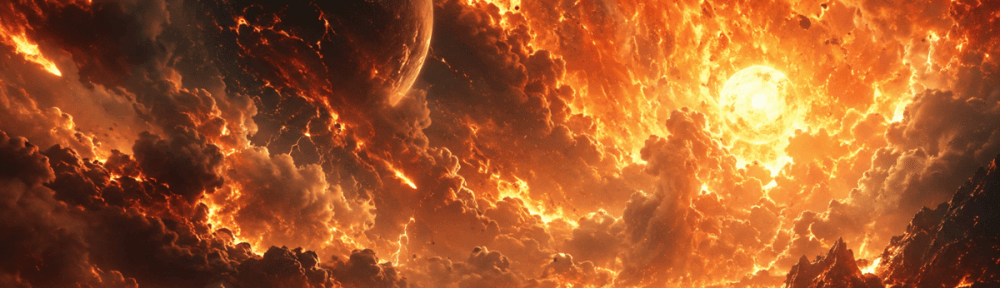
“The heavens will be dissolved in flames and the elements melted by fire” (2 Peter 3:12). Yikes! That was a hard start to our first reading. To modern ears, the language sounds catastrophic, end of the world kind of stuff. “Frightening” would be a bit of an understatement. If we had not told you it was from 2 Peter you would have probably thought it was from Revelation.
Yet for Peter’s original audience, the passage was intended less as a threat than as a call to perseverance and hope. The letter is addressed to Christians who were growing weary because Christ had not returned as soon as they expected. Earlier in the chapter, Peter mentions scoffers who ask, “Where is the promise of his coming?” (3:4). Some were beginning to doubt whether God’s promises would ever be fulfilled. Peter responds in three ways:
First, God’s timetable is not ours. “The Lord does not delay his promise” (3:9). What seems like delay is actually divine patience. God is giving humanity time to repent. Just before our reading, Peter instructed the people that “With the Lord one day is like a thousand years and a thousand years like one day. The Lord does not delay his promise, as some regard delay, but he is patient with you, not wishing that any should perish but that all should come to repentance.” (2 Peter 3:8-9) Peter is likely echoing the psalmist: “A thousand years in your sight are as yesterday, now that it is past, or as a watch of the night.” (Ps 90:4)
Second, the present world is not ultimate. The imagery of fire is drawn from the Jewish prophetic tradition. Fire often symbolizes God’s judgment, purification, and renewal. Peter’s point is not to provide a scientific description of cosmic destruction but to proclaim that evil, injustice, and sin will not have the last word. The prophet Malachi writes: “He is like a refiner’s fire… He will sit refining and purifying silver.” (Malachi 3:2-3). A refiner does not throw silver into the furnace to destroy it. The fire burns away impurities so that the silver becomes what it was meant to be.
Third, Christians should live now according to the future God is preparing. Because believers await “new heavens and a new earth in which righteousness dwell” (3:13), they are called to holiness, peace, and steadfastness. The emphasis falls not on fear of destruction but on hope for renewal.
In our times we face a different challenge but a similar temptation. We often become discouraged when God’s kingdom seems slow to appear. Wars continue, injustice persists, and the Church itself experiences weakness and scandal. Like Peter’s audience, we can wonder whether God’s promises are really unfolding. Peter’s answer remains relevant:
- God’s patience should not be mistaken for absence.
- History is moving toward God’s purposes, even when we cannot see it.
- Christians are called to live as citizens of the coming kingdom now.
The “new heavens and new earth” remind us that Christianity is not merely about escaping the world but about God’s intention to transform and renew creation.
There is an interesting contrast in the passage. Everything that appears permanent—the heavens, the earth, the structures of this world—will pass away. Yet the one thing that endures is what is rooted in God: faith, holiness, righteousness, and grace. Peter is essentially asking: If everything else is temporary, what kind of life is worth building? His answer comes at the end of the reading: “Grow in grace and in the knowledge of our Lord and Savior Jesus Christ” (3:18).
The Christian response to an uncertain future is neither fear nor speculation about the end times. It is growth in holiness, confidence in God’s promises, and faithful discipleship today. Things come and go, but we are called to keep our eyes fixed on the world God is bringing to birth.
Image credit: Created by ChapGPT, May 31 2026 | “The heavens will be dissolved in flames and the elements melted by fire” (2 Peter 3:12)
Discover more from friarmusings
Subscribe to get the latest posts sent to your email.


Divine patience gives a whole meaning to waiting patiently. Thank you.