 Wedding and Wine Imagery in Scripture. The image of a gamos = “wedding [banquet]” is used in synoptic gospel parables, as Stoffregen points out:
- “The kingdom of heaven may be compared to a king who gave a wedding banquet for his son” (Mt 22:2-12)
- The kingdom of heaven will be like this….while the ten maidens went to buy more oil, the bridegroom came, and those who were ready went with him into the wedding banquet; and the door was shut (Mt 25:10)
- “be like those who are waiting for their master to return from the wedding banquet” (Lk 12:36)
- “When you are invited by someone to a wedding banquet,… (Lk 14:8).
- In Revelation we have the image of the “marriage [supper]” of the Lamb (19:7, 9).
Also from Stoffregen,
“Wine was very important. It was the normal beverage at meals — and especially at festivals. Wine was a symbol of joy. One ancient rabbi stated, ‘Without wine there is no joy.’ At the same time, drunkenness was a great disgrace throughout scriptures. I don’t believe that Jesus intended all the guests to drink up all the wine that night. There was enough wine to satisfy a large number of guests throughout the rest of the wedding feast week.”
“Although the Greek word oinos is not used in any of the eucharist accounts — they all use ‘cup’ and the synoptics also use the phrase ‘fruit of the vine’ — the Cana miracle and the multiplication of the loaves early in church history became symbols for the bread and wine of the eucharist.”
“In the OT, an abundance of good wine is an eschatological symbol, a sign of the joyous arrival of God’s new age: On this mountain the LORD of hosts will make for all peoples a feast of rich food, a feast of well-aged wines, (Is 25:6a); The mountains shall drip sweet wine, and all the hills shall flow with it (Amos 9:13cd); In that day the mountains shall drip sweet wine, the hills shall flow with milk (Joel 3:18a)”
Minimizing miracles. In many 20th century commentaries, I am always surprised by the tendency among some scripture scholars to seek to explain away the miraculous. More than one (but thankfully not a lot) offers that Jesus, realizing people were well inebriated already, simply ordered the jar filled with water, and then the water taken to the master of the banquet who enters into the merriment while not wanting to embarrass the bridegroom, proclaims this wine to be the best. The bridegroom becomes a silent conspirator as the word spreads – and thus the miracle is born of rumor. Another avenue by which the miraculous is minimized is the suggestion that John adapted an Ancient Near East (ANE) legend. Similarly, several German scholars adopted the position that John had juxtaposed the Cana account with rites associated with the Greek god Dionysos. Gail O’Day [539] writes:
“The central act in the story of the wedding at Cana is the miraculous transformation of water into wine. The contemporary reader, living in a rational, scientifically oriented age, may find this miracle puzzling at best, embarrassing and offensive at worst. Interpreters, therefore, often are tempted to talk around the miracle by focusing on other aspects of the text or to explain away the miracle by focusing on the differences between the biblical worldview and the modern worldview. In preaching this text, however, the preacher should not get caught up in an explanation or apology (just as the preacher should never succumb to the temptation to explain the resurrection). The essence of any miracle is that it shatters conventional explanations and expectations, and this miracle is no exception. It is incumbent upon the preacher not to diminish the extraordinariness of this story in any way. The christological revelation of this story must not be reduced to a discussion about the facticity of the miracle. Contemporary hearers of this story must be allowed to struggle with what this miracle says about Jesus.”

 If you were here for one of the Christmas Masses, I hope you picked up and have unwrapped your Christmas present! We handed out almost 2,000 copies of Rediscover Jesus by Catholic author Matthew Kelly. (And if you were away, no worries, we have more of the books!) I hoped you have begun to read the 40 chapters – a chapter at a time. The book is not a novel that begs you to turn page after page until you reach the end. It is more a “40 day retreat” which offers you four practical invitations at the end of every chapter, each of which appeal to a different part of our being. To Ponder engages the mind, Verse to Live (taken from the Gospels) can engage almost any part of us; Question to Consider engages our memories and life experience, and Prayer engages our hearts. Almost every reader will find at least one of those four points striking. These invitations allow us as readers to reflect on the message of the chapter in a way that is deeply personal.
  The Theology of History. It is interesting to note that Luke relates no encounter between Jesus and John. In fact, before we are told about Jesus’ baptism, we are informed that John has been put in prison! A traditional way of understanding this order of events is that Luke (the rhetorical historian) divides history into three separate and distinct eras. The first is the time of the prophets, which includes John the Baptist. That era ends with the imprisonment of John. John will no longer be in the picture. After that, the time of Jesus begins with a statement in our text about: (1) the opening of the heaven, (2) the coming down of the Holy Spirit in a visible form (dove); and (3) heavenly speech. This era of Jesus ends with his ascension — related only in Luke & Acts. Jesus will no longer be in the picture. After that, the time of the Holy Spirit (or the Church) begins with a statement in Acts 2:1-4 about (1) something coming “from heaven,” (2) the coming down of the Holy Spirit in a visible form (tongues of fire), and (3) heavenly speech.
 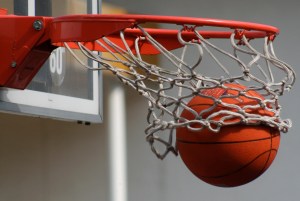 Recently I found myself on a basketball court. I picked up the ball with visions of past glories rebounding in my head (…and those glories are more delusional than actual). As I positioned myself at the free-throw line it occurred to me that the ball had become noticeably heavier and that the basket was somewhat further away. Undaunted, I went through the routine and took the shot. The shot arched nicely through the winter air and in my mind the crowd broke out in a chorus of ….. air ball, air ball! … as the shot returned to earth well short of its intended destiny of “nothing but net.”
  friarmusings