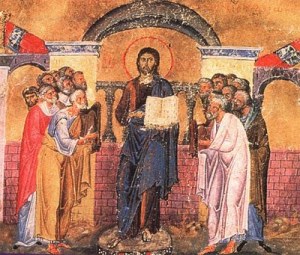
 1:1 Since many have undertaken to compile a narrative of the events that have been fulfilled among us, 2 just as those who were eyewitnesses from the beginning and ministers of the word have handed them down to us, 3 I too have decided, after investigating everything accurately anew, to write it down in an orderly sequence for you, most excellent Theophilus, 4 so that you may realize the certainty of the teachings you have received.
4:14 Jesus returned to Galilee in the power of the Spirit, and news of him spread throughout the whole region. 15 He taught in their synagogues and was praised by all. 16 He came to Nazareth, where he had grown up, and went according to his custom into the synagogue on the sabbath day. He stood up to read 17 and was handed a scroll of the prophet Isaiah. He unrolled the scroll and found the passage where it was written: 18 “The Spirit of the Lord is upon me, because he has anointed me to bring glad tidings to the poor. He has sent me to proclaim liberty to captives and recovery of sight to the blind, to let the oppressed go free, 19 and to proclaim a year acceptable to the Lord.” 20 Rolling up the scroll, he handed it back to the attendant and sat down, and the eyes of all in the synagogue looked intently at him. 21 He said to them, “Today this scripture passage is fulfilled in your hearing.” (Luke 1:1-4, 4:14-21)
Continue reading →

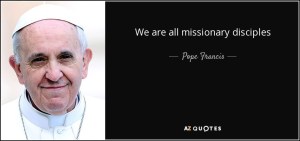 Catholics, in general, are reluctant to talk about their faith in the presence of others. Why? It is easy to talk about church issues and controversies or moral values but not about our relationship with Christ or about how we recognize God’s action in our lives. It seems socially ungracious to “talk religion” around the water cooler or on the golf course or at the swimming pool. Maybe some Catholics have grown up without clear knowledge of their beliefs, and therefore, feel inadequate to explain or defend the faith. Others may feel that religion is a private matter. Continue reading
 The “Wedding at Cana” story comes from the second chapter of John, but allow me to draw your attention to the first chapter. In the beautiful prologue of John’s Gospel, we hear in John 1:14 – “And the Word became flesh and made his dwelling among us, and we saw his glory, the glory as of the Father’s only Son, full of grace and truth.” Full of grace and truth. Now, here at Cana Jesus is drawn into the public light for all to begin to see, witness, and understand – that the fullness of grace and truth stands among us, dwelling with us in all the wonders of this life. This is what grace looks like.
 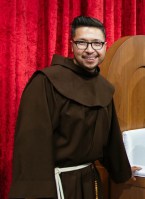 This weekend, Fr. Dan is representing the friars and the Sacred Heart community at the ordination of Brother Michael Reyes, OFM, at St. Francis of Assisi Church in Manhattan. Michael is an amazing artist who has trained and practiced in his own work, but with the friars has expanded his portfolio to include the creation of icons. Michael was blessed to train under Brother Robert Lentz, OFM, one of the leading iconographers in the United States. Sometime after June 2017, Brother Michael will pursue a Masters in Fine Arts.
  friarmusings